Fly Agaric
Amanita muscaria
Type: Gilled mushroom
Physical Characteristics
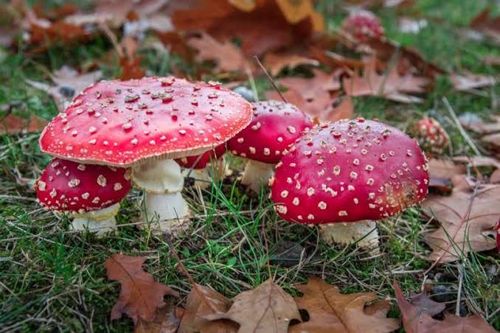
The Fly Agaric is a distinctive mushroom. Its cap is typically bright red to orange-red, covered with white to yellowish, wart-like patches (remnants of the universal veil). The cap can range from 8-20 cm (3-8 inches) in diameter, initially rounded, flattening with age, and often slightly depressed in the center. The gills are white, crowded, and free from the stem. The stem is white, 5-20 cm (2-8 inches) tall and 1-3 cm (0.4-1.2 inches) thick, usually tapering slightly upwards from a swollen base. It has a prominent, skirt-like white ring (annulus) and a volva at the base of the stem, often breaking into concentric rings or scales.
Habitat & Growing Conditions
Amanita muscaria is a mycorrhizal fungus, forming symbiotic relationships with certain trees, particularly conifers (pines, spruces, firs) and deciduous trees (birches, oaks). It is commonly found growing on the ground in forests, woodlands, and sometimes in parks or gardens, often appearing directly from the soil near host trees.
Season & Fruiting Time
Typically found from late summer through autumn, especially after periods of rain. Its fruiting is dependent on temperature and moisture conditions that favor its mycorrhizal host trees.
Similar Looking Species
Similar looking species include other red-capped Amanita species, such as Amanita parcivolvata (which lacks a ring) and some varieties of Amanita frostiana (which is typically smaller with yellowish universal veil remnants). The distinct white warts on the cap, the white ring, and the volva at the base of the stem are key identifiers for Amanita muscaria.
Ecological Role
Amanita muscaria plays a vital ecological role as an ectomycorrhizal symbiont. It forms mutually beneficial relationships with the roots of trees, extending the root system's reach and enhancing the tree's ability to absorb water and nutrients (especially phosphorus and nitrogen) from the soil. In return, the fungus receives carbohydrates produced by the tree through photosynthesis. This symbiotic relationship is crucial for the health and growth of many forest ecosystems.
Safety reminder
AI mushroom identification is a best-effort estimate and can be wrong. Never use it to decide whether a mushroom is safe to handle or eat — always confirm with a qualified mycologist before any consumption.
Identified on: 9/8/2025
Mode: Standard