
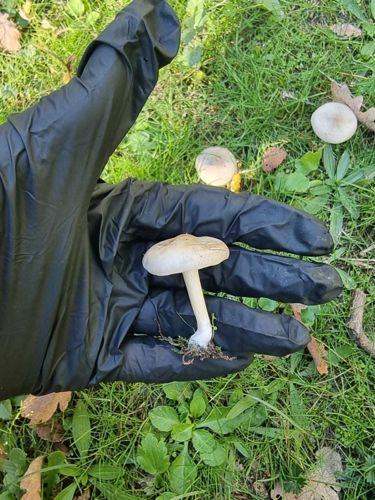
Community find
Pluteus
Pluteus spp.
- Group
- gilled mushroom
- Season
- Pluteus species are generally found from late spring through to autumn, with peak fruiting often occurring in late summer and early autumn, depending on local weather conditions and species.
- Habitat
- Pluteus species are saprophytic, meaning they grow on dead wood, often buried wood, wood chips, or sawdust. They can be found in a variety of habitats including forests, parks, gardens, and along roadsides. The presence of grass suggests it may be growing from buried wood or roots in a grassy area.
- Key characteristics
- The mushroom shown has a cap that is off-white to light brown, somewhat conical to bell-shaped with a slightly darker central area, and possibly finely fibrillose or radially streaked. The gills are visible beneath the cap and appear to be free from the stem. The stem is relatively thin, white or off-white, and lacks a ring (annulus) or volva at its base. The root-like structure at the base suggests it might be growing from buried wood. The spores of Pluteus species are typically pinkish.
- Look-alikes
- Other species within the genus Pluteus can look similar. Some Entoloma species also have pink gills, but they typically have an adnate or sinuate gill attachment to the stem and often have a different cap texture. Volvariella species also have pink spores and a volva at the base of the stem, which is not clearly visible here but if present would distinguish it. Differentiating between Pluteus species often requires microscopic examination of spores and other features.
- Ecological role
- Pluteus species are saprophytic, playing a crucial role in the decomposition of dead wood. By breaking down lignin and cellulose, they help recycle nutrients back into the ecosystem, contributing to soil health and forest regeneration.