Shaggy Parasol
Chlorophyllum rhacodes
Type: gilled mushroom
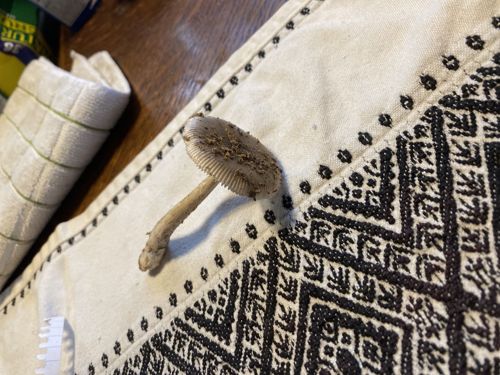
Physical Characteristics
Cap: 5-15 cm in diameter, initially egg-shaped, expanding to convex and then nearly flat. Surface is typically covered with large, shaggy, brown scales over a whitish or grayish background. The center often remains smooth and brownish. Gills: Free from the stem, crowded, and white, turning reddish-brown when bruised. Spore print: White. Stem: 8-20 cm long, 1-2.5 cm thick, tapering slightly upward, whitish, smooth, and typically has a movable ring. It does not have a bulbous base and does not stain yellowish when bruised.
Habitat & Growing Conditions
Typically found growing singularly or in small groups on disturbed ground, in gardens, lawns, woodlands, and along roadsides. It is a saprobic species, feeding on decaying organic matter in the soil.
Season & Fruiting Time
Late summer to autumn, though it can appear earlier in wet conditions.
Similar Looking Species
The most similar looking species is Chlorophyllum molybdites (Green-spored Parasol), which has a greenish spore print and bruises green. Lepiota procera (Parasol Mushroom) is also similar but has a patterned, snake-skin like stem (snakeskin pattern on the stipe) and often a more pronounced central umbo. Macrolepiota clelandii (Slender Parasol) is another very similar species, distinguished by subtle microscopic features and often a more slender stature.
Ecological Role
This mushroom is saprobic, meaning it obtains nutrients by breaking down dead organic material in the soil. It plays an important role in nutrient cycling and decomposition within its ecosystem.
Safety reminder
AI mushroom identification is a best-effort estimate and can be wrong. Never use it to decide whether a mushroom is safe to handle or eat — always confirm with a qualified mycologist before any consumption.
Identified on: 9/10/2025
Mode: Standard