
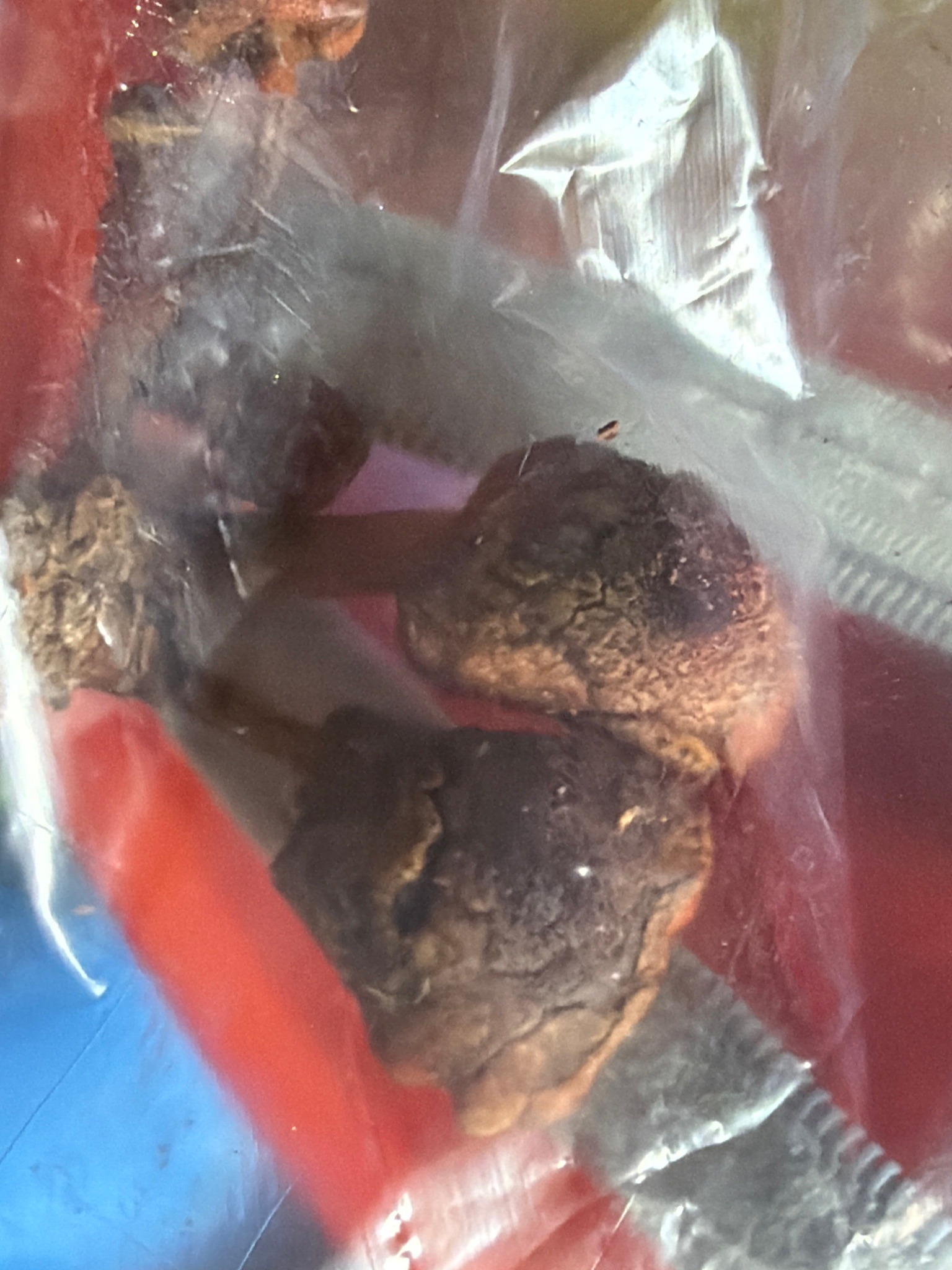
Community find
Psilocybe cubensis (Dried)
Psilocybe cubensis
- Group
- gilled mushroom
- Spore print
- Dark purple-brown
- Size
- Fresh cap: 2-8 cm diameter; Fresh stipe: 4-15 cm long by 0.5-1.5 cm thick.
- Season
- Fruits year-round in humid tropical climates, typically following heavy rainfall.
- Habitat
- Found in manure of large herbivores (primarily cattle), enriched soils, and tropical/subtropical grasslands.
- Distribution
- Widespread in tropical and subtropical regions including the Gulf Coast of the United States, Mexico, Central/South America, Southeast Asia, and Australia.
- Key characteristics
- Dried specimens show dark, shriveled caps often with a golden-brown or yellowish hue in the center, slender fibrous stems that typically show blue or dark bruising, and dark purple-brown gills.
- Fruiting body
- In life, the cap is 2-8cm, conic to convex, becoming planoconvex with age, viscid when moist. Hymenophore consists of adnate to adnexed gills. Stipe is 4-15cm long, often with a white membranous ring (annulus) that may be stained by spores.
- How to recognise it
- Look for the characteristic 'bluing' reaction where the flesh is bruised or damaged, the presence of a persistent ring on the stipe, and growth directly on or near manure in warm climates.
- Look-alikes
- Protostropharia semiglobata (lacks blue bruising), Deconica species (often smaller and lack blue bruising), and various Panaeolus species.
- Ecological role
- Saprophytic, breaking down organic matter in dung and enriched soil.
- Notes
- This species was first described scientifically in 1906 by Franklin Sumner Earle in Cuba. In mycology, it is one of the most widely studied species within its genus due to its ease of cultivation in laboratory settings.