
Community find
Purple Cort
Cortinarius iodes
- Group
- Gilled mushroom
- Season
- Typically found from late summer through fall.
- Habitat
- This mushroom is mycorrhizal, forming symbiotic relationships with hardwood trees, particularly oak. It grows scattered or gregariously on the ground in deciduous and mixed forests. It prefers well-drained soil.
- Key characteristics
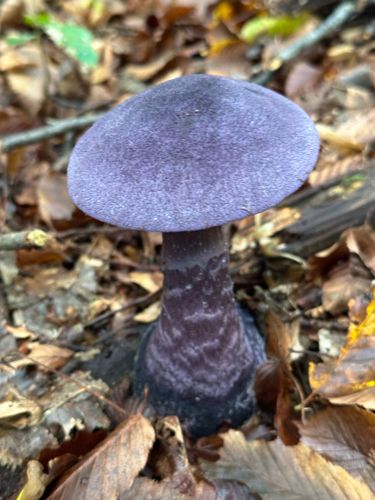
- The cap is typically 2-6 cm wide, convex to broadly convex or nearly flat in age, and can be viscid (slimy) when moist. Its color is generally vibrant purple when young, often fading to a purplish-brown or lilac-brown as it matures. The gills are attached to the stem, close, and purple to violet when young, often turning rusty brown as spores mature. The stem is 3-10 cm long and 0.5-1.5 cm thick, often tapering slightly to the base, and covered with sticky purplish slime, especially when young, and may have faint purple velar remnants. The spore print is rusty brown. The flesh is pale lilac to whitish.
- Look-alikes
- Cortinarius iodeoides is a very similar species that is generally less purple and often has yellowish or brownish areas on the cap, and bitter-tasting flesh. Other purple Cortinarius species can be difficult to distinguish without microscopic examination.
- Ecological role
- Cortinarius iodes is a mycorrhizal fungus, meaning it forms a symbiotic relationship with the roots of trees, particularly hardwoods like oak. It helps the trees absorb water and nutrients from the soil, while the trees provide the fungus with carbohydrates produced through photosynthesis. This relationship is crucial for the health and growth of many forest ecosystems. It also plays a role in nutrient cycling within its habitat.