Community find
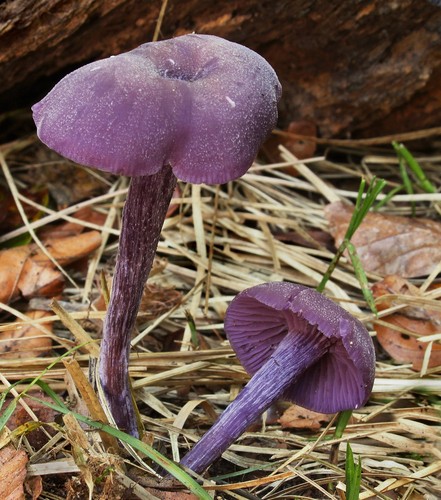
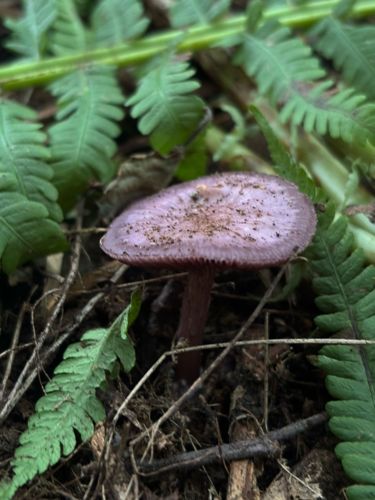
Purple Laccaria
Laccaria amethystina
- Group
- gilled mushroom
- Season
- Commonly found from late summer through fall, especially after periods of rain.
- Habitat
- Typically found growing scattered or in small groups on humus, moss, or decaying conifer wood, especially in coniferous or mixed forests.
- Key characteristics
- The cap is typically purplish-brown to reddish-brown, often convex to flat, sometimes with a central depression. Its surface is smooth to slightly scaly, and it can be moist or dry. The gills are adnate to decurrent, widely spaced, and the same color as the cap or slightly paler, sometimes with reddish tones. The stem is solid, fibrous, often longitudinally striate, and generally matches the cap color, though it can be darker towards the base. Spore print is white.
- Look-alikes
- Laccaria ochropurpurea has a similar purple cap but has purple gills that fade to whitish or yellowish and a distinctively robust, often much thicker stem. Some species of Cortinarius can have purple caps and stems, but they typically have an rusty-brown spore print and a cobweb-like partial veil (cortina) when young.
- Ecological role
- This mushroom is saprophytic, meaning it obtains nutrients by breaking down dead organic matter. It plays a crucial role as a decomposer in forest ecosystems, returning nutrients to the soil and facilitating the cycling of matter.