Agaricus mushroom (common name varies by specific species, e.g., Meadow Mushroom, Horse Mushroom, Field Mushroom)
Agaricus sp.
Type: Gilled mushroom
Physical Characteristics
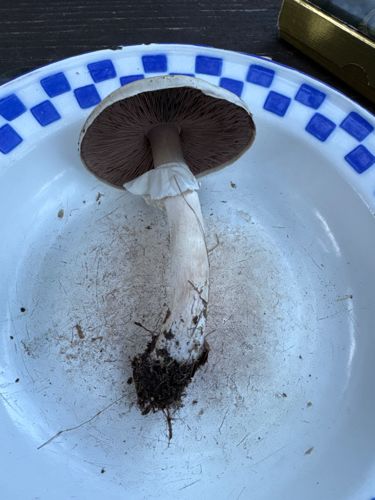
The mushroom in the image appears to be a gilled mushroom, likely from the genus Agaricus. Key features visible are: Cap: Off-white to light brown, convex to broadly convex. Gills: Detached from the stem (free gills), starting as pinkish and darkening to brown/chocolate brown with maturity, which is characteristic of Agaricus species due to the color of their spores. Stem (Stipe): White to off-white, cylindrical, with a prominent ring (annulus) which is an important feature for identification within the genus. The base appears to have some soil clinging to it.
Habitat & Growing Conditions
The specific Agaricus species is widely distributed and often found in a variety of habitats including grassy areas, lawns, meadows, pastures, gardens, and sometimes in woodlands. They are typically terrestrial, growing directly from the soil.
Season & Fruiting Time
Agaricus species typically fruit from late spring through to autumn, especially after periods of rain. The exact season can vary slightly depending on the specific species and local climatic conditions.
Similar Looking Species
There are many species within the genus Agaricus that can look similar, making specific identification challenging without detailed microscopic examination and spore print analysis. Some common look-alikes include other Agaricus species (e.g., Agaricus campestris, Agaricus arvensis, Agaricus bisporus) which share the brown gills and ring. Distinguishing features often involve subtle differences in cap color, bruising reactions, smell, and the structure of the ring. It is important to note that some toxic species (e.g., Chlorophyllum molybdites or certain white-gilled Amanita species when immature, though the gill color here rules out Amanita) can be confused with edible Agaricus species, but the distinct dark brown gills of mature Agaricus as seen in the image are a key differentiating factor from these other genera that typically have white gills.
Ecological Role
Agaricus species are saprophytic, meaning they obtain nutrients by decomposing organic matter in the soil, such as leaf litter, wood debris, and other decaying plant material. They play a crucial role in nutrient cycling, breaking down complex organic compounds into simpler forms that can be reused by plants and other organisms.
Safety reminder
AI mushroom identification is a best-effort estimate and can be wrong. Never use it to decide whether a mushroom is safe to handle or eat — always confirm with a qualified mycologist before any consumption.
Identified on: 7/22/2025
Mode: Standard