Community find
Red-capped Scaber Stalk
Leccinum aurantiacum
- Group
- Boletes
- Season
- Typically found from summer through autumn, often after periods of rain.
- Habitat
- This mushroom forms a mycorrhizal association primarily with aspen, birch, or oak trees, growing scattered or in groups on the ground in woodlands and forests. It prefers well-drained soil.
- Key characteristics
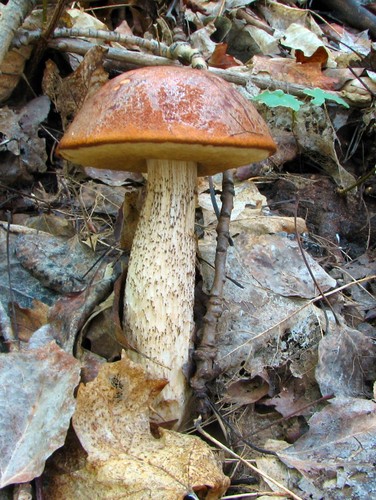
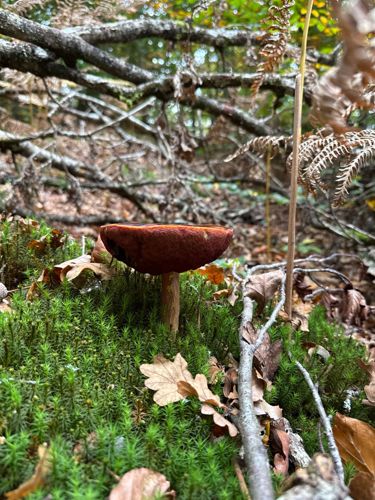
- The cap of Leccinum aurantiacum is typically 5-20 cm in diameter, convex to broadly convex, becoming flatter with age. It is characteristically brick-red, orange-red, or reddish-brown, often smooth but can be finely velvety or somewhat scaly. The pores on the underside are small, circular, and whitish to grayish, bruising brownish. The stem is solid, 8-20 cm long and 2-5 cm thick, tapering slightly towards the cap or base, whitish to tan with distinctive reddish-brown to black 'scabers' or scales. The flesh is white, turning grayish-pink, purplish-gray, or blackish when cut or bruised, especially in the stem. Spore print is brownish.
- Look-alikes
- Several Leccinum species can look similar. Leccinum versipelle (Orange Birch Bolete) has orange-capped varieties and often associates with birch, but typically has a yellowish-orange pore surface when young. Leccinum scabrum (Brown Birch Bolete) has a brown cap and usually associates with birch. Leccinum insigne (Aspen Bolete) is very similar and grows with aspen, but its cap color can vary from yellowish-orange to reddish-brown, and its flesh turns purplish-gray to blackish when cut.
- Ecological role
- Leccinum aurantiacum is a mycorrhizal fungus, forming a symbiotic relationship with certain tree species, particularly aspen, birch, and oak. It helps the trees absorb water and nutrients from the soil, while the trees provide the fungus with carbohydrates produced through photosynthesis. This symbiotic relationship is crucial for the health and growth of its host trees and the forest ecosystem.