Gymnopus dryophilus
Gymnopus dryophilus
Type: gilled mushroom
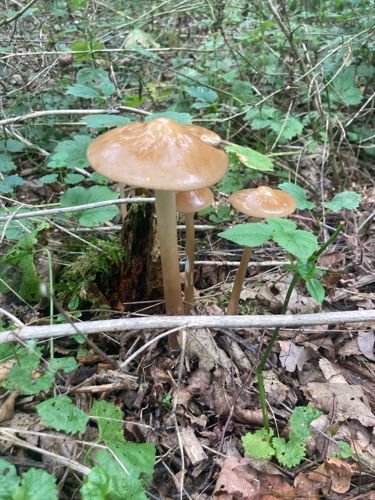
Physical Characteristics
The caps are typically convex to bell-shaped, often becoming flatter with age, with a distinct central bump (umbo). They are smooth, shiny, and quite slimy or viscid when moist, drying to a duller sheen. The color ranges from yellowish-brown to reddish-brown, often darker towards the center. Gills are adnate to adnexed, close to crowded, and whitish to pale yellow, becoming slightly tinged with spores as they mature. The stipe (stem) is slender, often tapering slightly upwards, with a texture similar to the cap; it can be whitish to pale brown. There is no ring.
Habitat & Growing Conditions
Typically found growing in clusters or scattered on decaying hardwood or conifer logs, stumps, and fallen branches. It can also appear on buried wood or directly on nutrient-rich soil in woodlands and forests.
Season & Fruiting Time
Commonly found from spring through autumn, especially after periods of rain. Its fruiting season can extend into early winter in milder climates.
Similar Looking Species
Several other species can look similar. 'Gymnopus peronatus' has a more yellowish-brown cap, a fuzzy or hairy stem base, and a peppery taste. 'Gymnopus confluens' grows in dense clusters, has densely packed gills, and a fuzzy stem. 'Collybia tuberosa' is much smaller and grows on the decaying caps of larger mushrooms. Careful examination of cap color, stem characteristics, and substrate is often needed for accurate identification.
Ecological Role
As a saprophytic fungus, it plays a crucial role in woodland ecosystems by decomposing decaying wood, leaves, and other organic matter on the forest floor. This process returns nutrients to the soil, making them available for other plants and organisms, thus contributing to nutrient cycling and soil health.
Safety reminder
AI mushroom identification is a best-effort estimate and can be wrong. Never use it to decide whether a mushroom is safe to handle or eat — always confirm with a qualified mycologist before any consumption.
Identified on: 7/28/2025
Mode: Standard