Community find
Scarletina Bolete / Lurid Bolete
Suillellus luridus (formerly Boletus luridus)
- Group
- Boletaceae / Bolete
- Season
- Summer to autumn, typically from July through October.
- Habitat
- Found on the ground in deciduous and coniferous forests, often associated with oaks, beeches, and spruces. Prefers acidic to neutral soils.
- Key characteristics
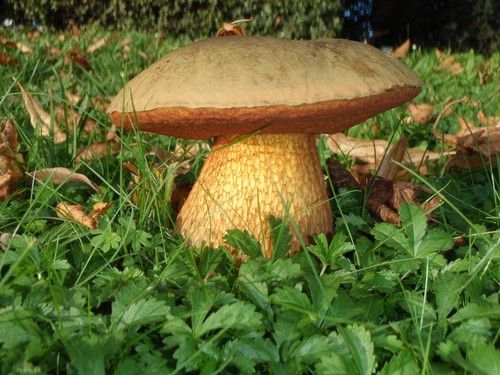
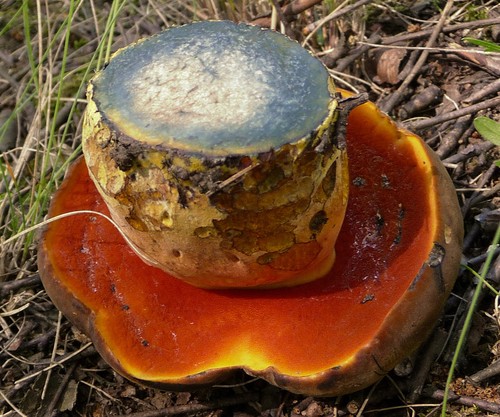
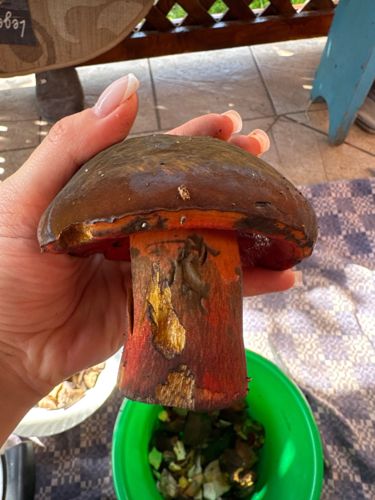
- Cap: Up to 20 cm in diameter, convex to broadly convex, dry, velvety or finely tomentose, dark brown, reddish-brown, or olive-brown. Pores: Red, orange, or reddish-orange, often bruising blue instantly. Stem: Robust, cylindrical or club-shaped, often reticulate (net-like pattern) with reddish or orange coloration, yellow near the apex, bruising blue on handling. Flesh: Yellowish, quickly staining blue when cut or bruised, especially in the cap and upper stem. Spore Print: Olive-brown.
- Look-alikes
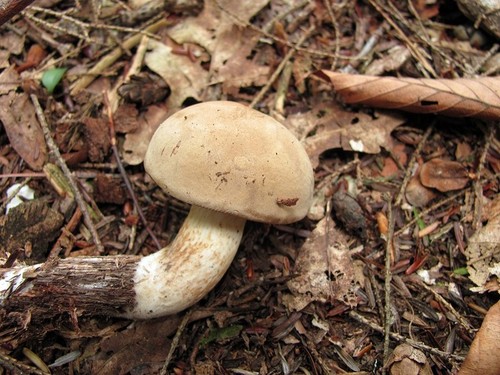
- Rubroboletus satanas (Satan's Bolete) has a paler cap (whitish to grayish) and may have a more pronounced reticulation on the stem. Imperator torosus (Donkey Bolete) has a more yellow to orange cap and a less strongly red stem base. It's crucial to identify boletes with red pores carefully due to potential look-alikes.
- Ecological role
- Mycorrhizal, forming symbiotic relationships with various deciduous and coniferous trees, particularly oaks, beeches, and spruces. This relationship benefits both the fungus and the tree, with the fungus helping the tree absorb nutrients and water, and the tree providing carbohydrates to the fungus.