Community find
Shaggy scalycap
Pholiota squarrosa
- Group
- gilled mushroom
- Season
- It is typically found from late summer through autumn, often after periods of rain.
- Habitat
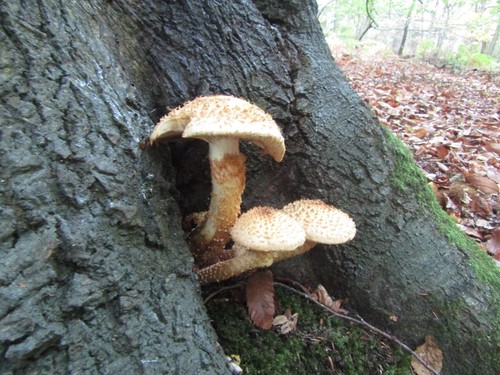
- This mushroom typically grows in clusters or singly on dead or living deciduous wood, particularly on beeches, oaks, and other hardwoods. It can also be found on conifers. It is often found at the base of trees or on stumps and buried wood.
- Key characteristics
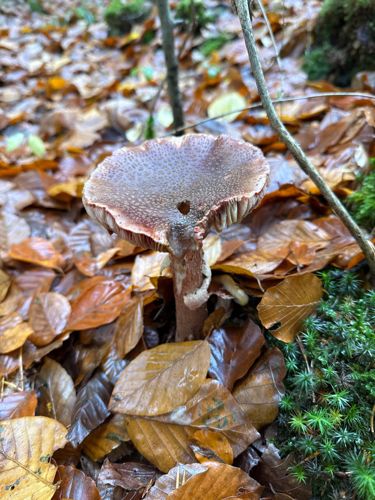
- The Shaggy Scalycap has a cap that is typically 5-15 cm in diameter, convex to broadly convex or nearly flat with age. It is covered in noticeable, raised, reddish-brown to cinnamon-brown scales against a yellowish-brown to olive-brown background. The margin is often inrolled when young and may have veil remnants. The gills are adnate to adnexed, close, yellowish at first, becoming rusty brown with age due to spore development. The stem is 5-15 cm long and 1-2.5 cm thick, roughly equal or slightly tapering towards the base. It is covered in shaggy scales similar to the cap, especially below the ring zone, which can be prominent and persistent. The spore print is rusty brown.
- Look-alikes
- Similar looking species include the Ringless Honey Mushroom (Armillaria tabescens) which lacks a ring and has white spores and an olive-greenish cap, and other Pholiota species. Pholiota squarrosoides is very similar but has a dry cap and typically prefers hardwood. Careful examination of cap texture, gill attachment, and spore print is necessary for accurate identification.
- Ecological role
- Pholiota squarrosa is a saprobic fungus, meaning it obtains nutrients by breaking down dead organic matter, primarily wood. It plays an important role in forest ecosystems by decomposing wood, thereby recycling nutrients back into the soil.