Community find
Slippery Jack
Suillus luteus
- Group
- Pored mushroom
- Season
- Late summer and autumn, often appearing after rain.
- Habitat
- Typically found on the ground, often in coniferous forests, especially under pine trees. It forms a mycorrhizal relationship with these trees, meaning it exchanges nutrients with the tree roots.
- Key characteristics
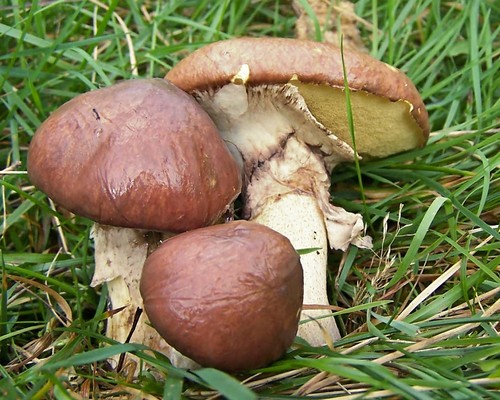
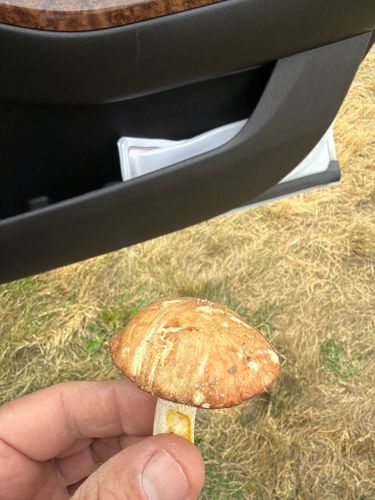
- The cap is typically sticky or slimy, especially when wet, and ranges in color from yellowish-brown to dark brown, often with radiating fibrils. It can be convex to broadly convex, flattening with age, and usually 5-15 cm in diameter. The pore surface underneath the cap is pale yellow, becoming darker and olive-brown with age, and does not stain significantly when bruised. The stem is whitish to yellowish, often with a prominent purplish-brown \"veil ring\" or annulus that starts as a membrane covering the pores. The stem is relatively solid and can be 3-10 cm long and 1-2.5 cm thick. The flesh is soft and whitish to pale yellow.
- Look-alikes
- Several other species within the genus Suillus look similar. Suillus granulatus (Granulated Bolete) has a granular ringless stalk. Suillus brevipes (Short-stemmed Suillus) has a much shorter stalk relative to its cap size and also lacks a prominent ring. Careful examination of the stem characteristics (presence or absence of a ring, granulation) and the stickiness of the cap can help differentiate them.
- Ecological role
- Slippery Jack is a mycorrhizal fungus, forming a symbiotic relationship with various conifer trees, particularly pines. The fungus assists the tree in absorbing water and nutrients from the soil, while the tree provides the fungus with carbohydrates produced through photosynthesis.