Panther Cap
Amanita pantherina
Type: gilled mushroom
Physical Characteristics
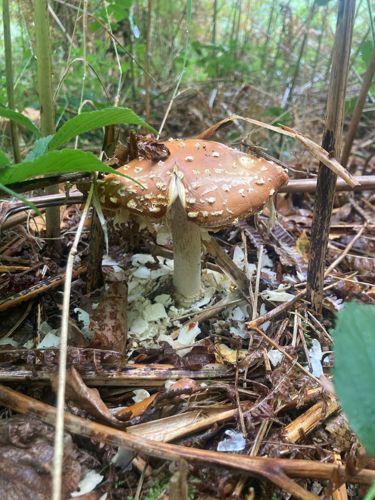
The species typically has a cap that is initially convex and becomes broadly convex to nearly flat with age, often exhibiting a depressed center. The cap color can range from reddish-brown to orange-brown, often with lighter margins, and is covered with scattered, whitish to yellowish, irregular warts or patches, which are remnants of the universal veil. The gills are free to adnexed, close, and white to cream. The stem is solid, central, and white to yellowish, often tapering slightly upwards, with a large, white or yellowish, felt-like ring (annulus) that may be persistent or disintegrate with age. The base of the stem is typically swollen and often has concentric rings or patches of universal veil remnants, forming a volva that is not sac-like but rather breaks into friable rings around the base. The spores are white.
Habitat & Growing Conditions
Typically found growing on the ground in various forest types, commonly associated with conifers (such as pine, spruce, fir) and sometimes hardwoods (like birch, oak, beech). It prefers well-drained, acidic to neutral soils.
Season & Fruiting Time
Commonly found during late summer and autumn, especially after periods of rainfall. Its fruiting season can extend from July to November depending on the geographical location and prevailing weather conditions.
Similar Looking Species
The species can be confused with other species of Amanita. It is often mistaken for Amanita muscaria (Fly Agaric), which typically has red or orange caps and white warts, and A. rubescens (Blushing Amanita), which stains reddish when bruised and lacks the distinct prominent volval remnants. Careful observation of the cap color, volva type, and gill attachment is crucial for differentiation.
Ecological Role
This species forms a mycorrhizal association with various trees, exchanging nutrients with the host plant to facilitate growth of both organisms. It plays a crucial role in nutrient cycling within forest ecosystems, aiding trees in absorbing water and minerals from the soil.
Safety reminder
AI mushroom identification is a best-effort estimate and can be wrong. Never use it to decide whether a mushroom is safe to handle or eat — always confirm with a qualified mycologist before any consumption.
Identified on: 8/23/2025
Mode: Standard