Fairy Ring Mushroom
Marasmius oreades
Type: gilled mushroom
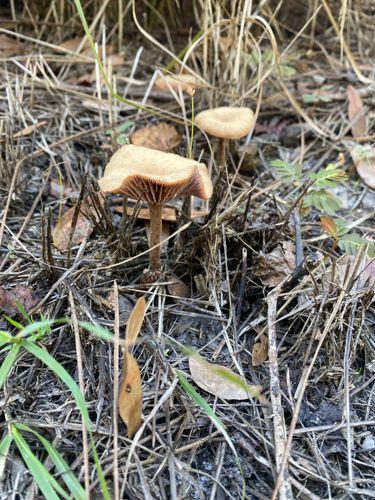
Physical Characteristics
Cap: 1-5 cm wide, bell-shaped to convex, flattening with age, sometimes with a central umbo; smooth, dry, and often rugulose (wrinkled) when dry. Color ranges from buff to tan or reddish-brown, fading when dry (hygrophanous). Gills: Free to adnate, widely spaced, and pale cream to buff. Stems: 2-10 cm long, slender, tough, cartilaginous, often twisted, and colored similarly to the cap, sometimes paler.
Habitat & Growing Conditions
Typically found in grassy areas such as lawns, meadows, pastures, and along roadsides. It often grows in distinct arcs or rings, known as "fairy rings". It favors disturbed ground.
Season & Fruiting Time
Spring, summer, and fall, particularly after rainfall.
Similar Looking Species
There are several similar-looking species. 'Melanoleuca cognata' has more crowded gills and grows in different habitats. Some 'Clitocybe' species can appear similar but often have decurrent gills and a different odor. Care must be taken to distinguish it from species like 'Galerina marginata', which is a deadly poisonous mushroom; 'M. oreades' can be distinguished by its tough, flexible stem, widely spaced gills, and growth habit.
Ecological Role
Saprotrophic, decomposing organic matter in soil and contributing to nutrient cycling in grassy ecosystems. Its ability to form fairy rings indicates its extensive mycelial network in the soil.
Safety reminder
AI mushroom identification is a best-effort estimate and can be wrong. Never use it to decide whether a mushroom is safe to handle or eat — always confirm with a qualified mycologist before any consumption.
Identified on: 12/5/2025
Mode: Standard