Deer Mushroom
Pluteus cervinus
Type: gilled mushroom
Physical Characteristics
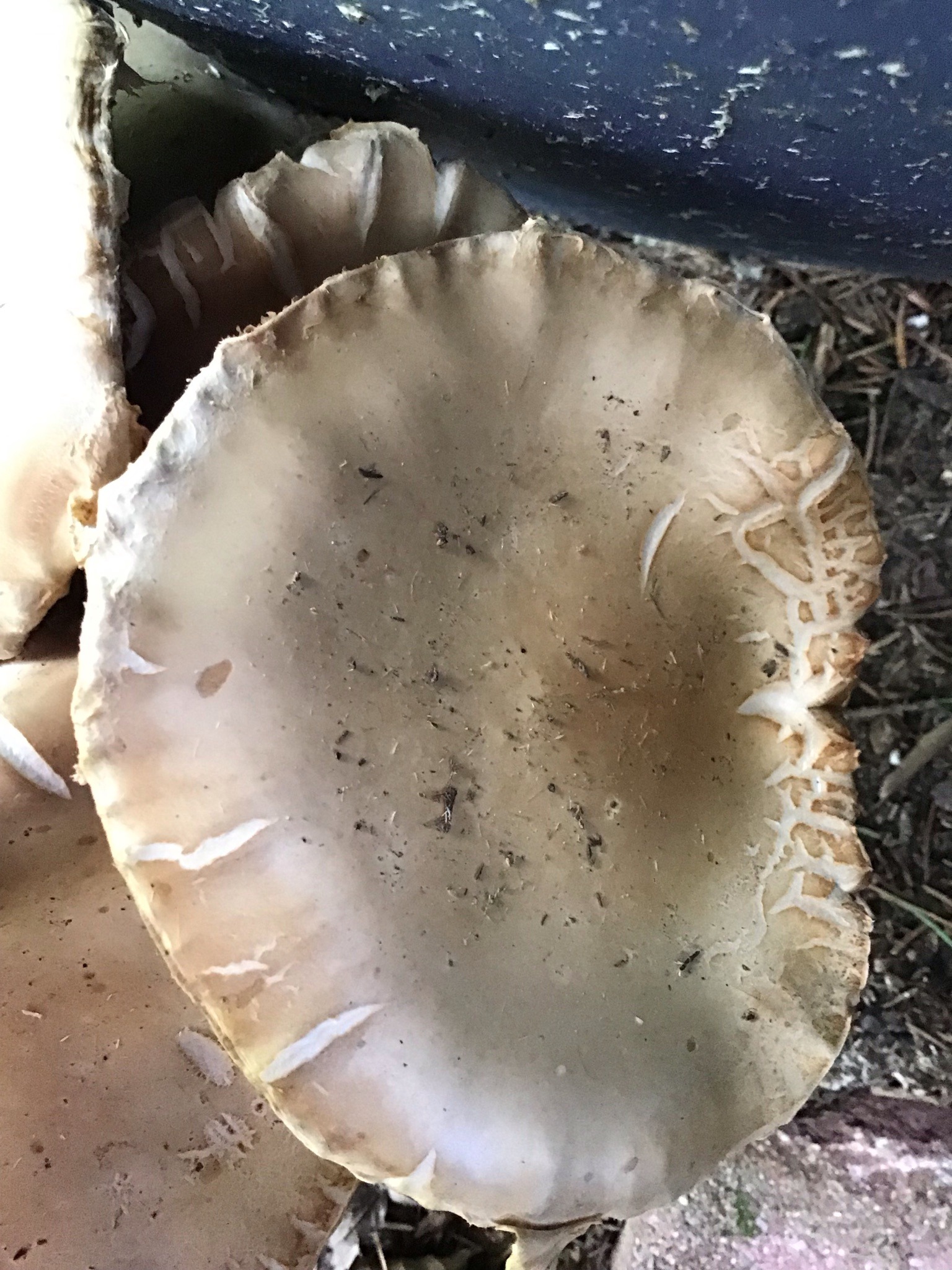
Gray-brown to dark brown smooth cap that is often slightly wrinkled or streaked with fine fibers; free gills that start white and turn pinkish as spores mature; usually found on decaying wood or buried wood.
Habitat & Growing Conditions
Found growing on dead wood, including logs, stumps, and piles of wood chips, as well as soil containing buried wood.
Season & Fruiting Time
Spring through autumn in most temperate regions, often after heavy rain.
Similar Looking Species
Pluteus petasatus (lighter cap, prefers wood chips), Megacollybia rodmanii (white gills, has rhizoids/thick white cords at base), Entoloma species (which grow on the ground, never on wood, and have attached gills).
Ecological Role
Saprophytic, breaking down hardwood and sometimes softwood debris.
Fruiting Body
The cap is convex to broadly convex or flat, often with a slight central bump (umbo). The hymenophore consists of crowded, broad gills that are free from the stem. The stipe is solid, white to grayish, and lacks both a ring and a volva.
Size
Cap diameter 3–12 cm; stipe length 5–13 cm and 0.5–1.5 cm thick.
Spore Print
Pink to salmon-pink
Distribution
Widely distributed across North America, Europe, and parts of Asia.
Identification Tips
Look for pink gills that are clearly 'free' (not touching the stem) and a preference for growing directly on wood. The cap skin can be peeled away easily.
Interesting Facts
The scientific name 'cervinus' is Latin for 'deer-like,' referring to the cap color. Although it is a common species, it is part of a complex of several genetically distinct species that look almost identical to the naked eye.
Safety reminder
AI mushroom identification is a best-effort estimate and can be wrong. Never use it to decide whether a mushroom is safe to handle or eat — always confirm with a qualified mycologist before any consumption.
Identified on: 5/19/2026
Mode: Standard