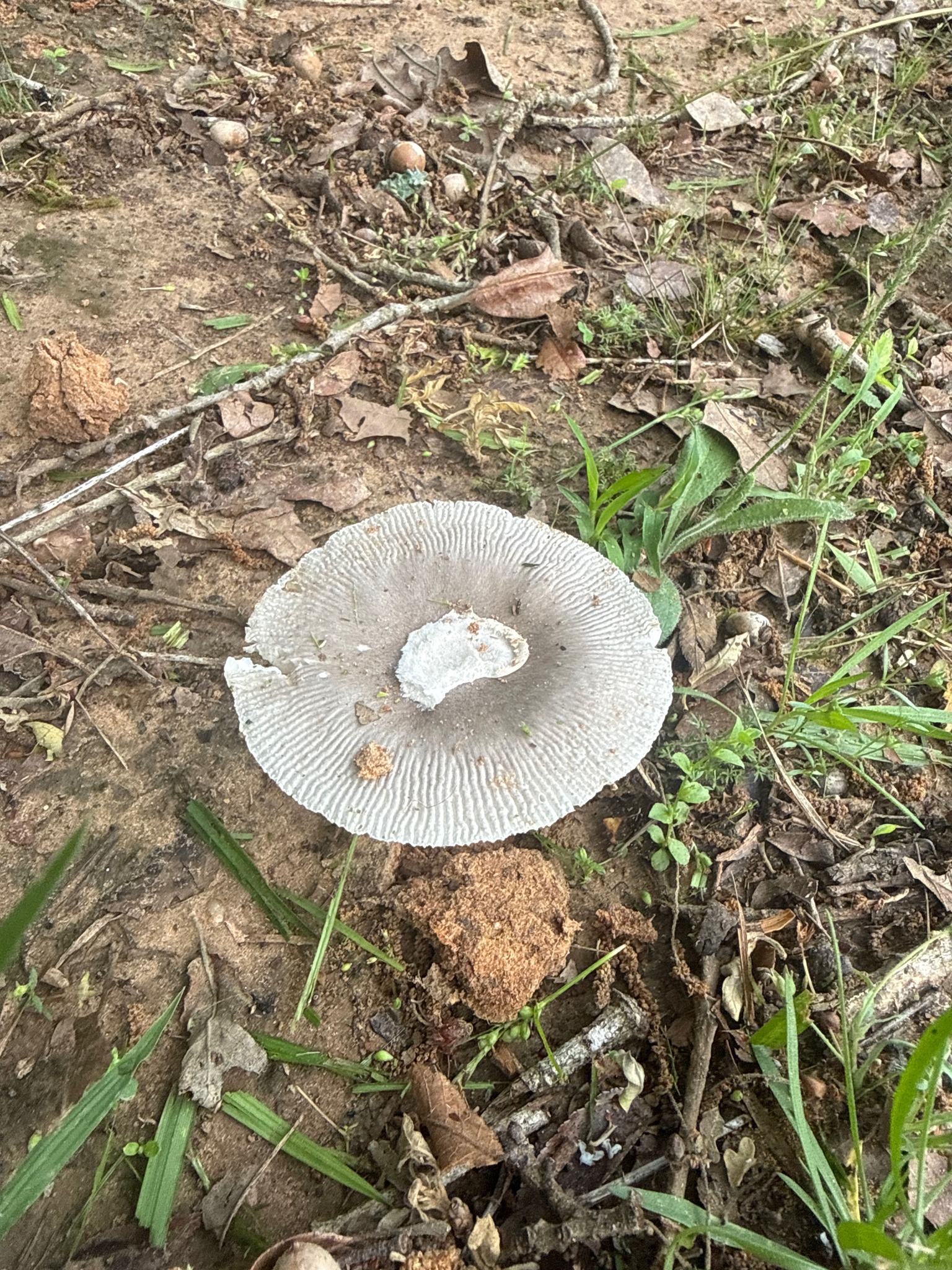
Grisette (likely Amanita vaginata group)
Amanita vaginata
Type: gilled mushroom
Physical Characteristics
Greyish cap with deeply striate (grooved) margins, lacking a ring (annulus) on the stem, and emerging from a bag-like volva at the base.
Habitat & Growing Conditions
Found on the ground in both deciduous and coniferous forests; common in woodland clearings or trail edges.
Season & Fruiting Time
Summer to early autumn, typically after significant rainfall.
Similar Looking Species
Amanita ceciliae (snakeskin grisette), which is larger with warts; Amanita pachycolea (western grisette), which is larger and darker.
Ecological Role
Mycorrhizal, forming symbiotic relationships with the root systems of various trees.
Fruiting Body
Cap is initially ovoid then expands to convex or flat, often with a central bump (umbo), silvery-grey to brownish-grey. Hymenophore consists of free, white, crowded gills. Stipe is slender, white to pale grey, fragile, and lacks a ring. Base is encased in a white, sack-like volva.
Size
Cap diameter: 3-10 cm; Stipe: 8-15 cm long, 0.5-1.5 cm thick.
Spore Print
White
Distribution
Widespread across the Northern Hemisphere, including North America, Europe, and Asia.
Identification Tips
Look for the very prominent radial grooves (striations) on the cap edge, the total absence of a ring on the stem, and the sack-like volva at the very base of the stem (often buried).
Interesting Facts
Members of the Amanita section Vaginatae are unique within the genus because they strictly lack a partial veil, meaning they never develop a ring on the stalk. The 'Amanita vaginata' name likely represents a complex of many closely related, similar-looking species rather than a single global species.
Safety reminder
AI mushroom identification is a best-effort estimate and can be wrong. Never use it to decide whether a mushroom is safe to handle or eat — always confirm with a qualified mycologist before any consumption.
Identified on: 4/18/2026
Mode: Standard