Giant Polypore
Meripilus giganteus
Type: Polypore
Physical Characteristics
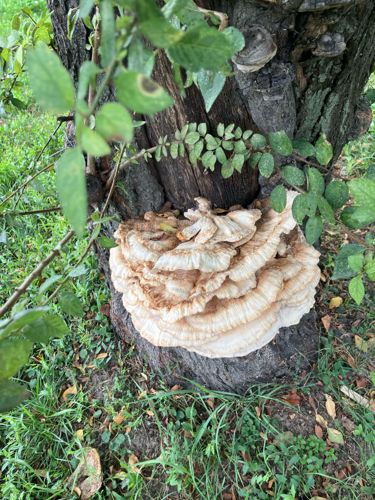
The fruit body consists of numerous wavy, fan-shaped to spatulate caps, united at a common base, forming a large rosetted or shelving cluster. Caps can be individually 10-50 cm broad. The color ranges from whitish to pale buff or light brown, often darkening with age or bruising to black. The margin is thin and often wavy. The pore surface is white to cream and bruises dark brown to black. Pores are tiny and circular to angular. The flesh is white and firm when young, becoming tougher with age.
Habitat & Growing Conditions
Typically found at the base of living deciduous trees (especially oak, beech, and chestnut) or on buried roots. It causes white rot in the heartwood of the host tree.
Season & Fruiting Time
Late summer to autumn.
Similar Looking Species
Similar looking species include Hen of the Woods (Grifola frondosa), which has a more grayish and often smaller, more numerous fronds, and is typically found growing as a cluster of individual rosettes. Berkeley's Polypore (Bondarzewia berkeleyi) is also a large, basal polypore, but its caps are usually paler and do not bruise black as readily. Black-staining Polypore (Meripilus sumstinei) is considered synonymous by some, or a closely related North American species, sharing the characteristic black bruising.
Ecological Role
This fungus is parasitic on living deciduous trees, particularly oaks, causing a white rot in the heartwood of the trunk and roots. It becomes saprobic on the dead wood after the tree dies. It plays a role in the decomposition of wood, recycling nutrients back into the ecosystem.
Safety reminder
AI mushroom identification is a best-effort estimate and can be wrong. Never use it to decide whether a mushroom is safe to handle or eat — always confirm with a qualified mycologist before any consumption.
Identified on: 9/28/2025
Mode: Standard