Turkey Tail
Trametes versicolor
Type: Polypore
Physical Characteristics
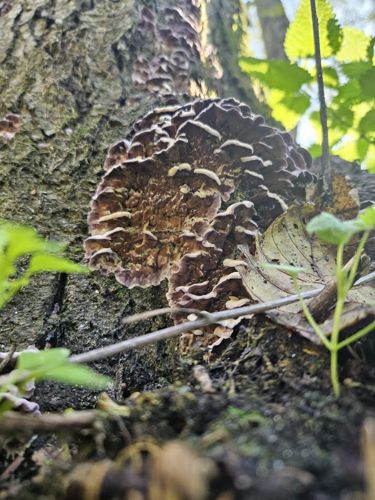
Turkey Tail mushrooms are thin, leathery fungi that grow in a shelf-like or rosette-like pattern. They are characterized by concentric zones of different colors, often displaying shades of brown, gray, blue, red, and black, with a distinctive velvety or finely hairy surface. The margin is typically wavy and light-colored. The underside is white to off-white, covered with tiny pores (not gills), numbering 3-8 pores per millimeter.
Habitat & Growing Conditions
This very common bracket fungus is saprophytic, growing on dead hardwood logs, stumps, and branches, and occasionally on conifers. It can be found in a variety of forested environments.
Season & Fruiting Time
Turkey Tail can be found year-round in many climates, fruiting most actively from late spring through fall, and often persisting through winter.
Similar Looking Species
Several species can be confused with Trametes versicolor. Stereum hirsutum (Hairy curtain crust) has a similar appearance but lacks pores on its underside (it has a smooth to slightly wrinkled spore-bearing surface). Trametes ochracea has a thicker, usually less colorful cap and also has pores. Trametes pubescens is whiter and less distinctly zoned. Daedaleopsis confragosa (Thin-maze flat polypore) has an underside that resembles a maze or labyrinth rather than distinct pores.
Ecological Role
Trametes versicolor is a very important decomposer (saprophyte) in forest ecosystems. It breaks down cellulose and lignin in dead wood, playing a crucial role in nutrient cycling and making nutrients available for other organisms. It helps in clearing forest floors of woody debris, thereby aiding forest regeneration.
Safety reminder
AI mushroom identification is a best-effort estimate and can be wrong. Never use it to decide whether a mushroom is safe to handle or eat — always confirm with a qualified mycologist before any consumption.
Identified on: 11/3/2025
Mode: Standard