Liberty Cap
Psilocybe semilanceata
Type: gilled mushroom
Physical Characteristics
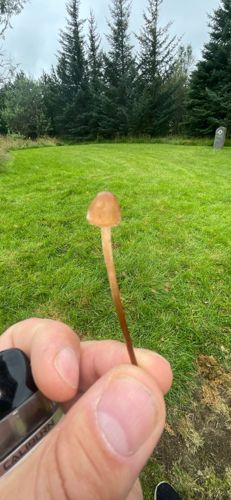
The cap is conical to bell-shaped, 0.5-2.5 cm in diameter, moist and sticky when fresh, drying to a dull ochre or pale yellowish-brown. It often has a prominent nipple-like papilla at the apex. The color changes with moisture (hygrophanous), from dark brown when wet to light tan when dry, often with a darker margin. Gills are adnexed or adnate, close, and typically cream to grayish-purple-brown. The stem is slender, tough, wavy, 4-10 cm long, 1-3 mm thick, whitish to pale yellowish-brown, sometimes staining bluish at the base when handled or damaged. Spore print is dark purplish-brown.
Habitat & Growing Conditions
Found in grasslands, pastures, meadows, and lawns, often in rich, acidic soil, especially where sheep or cattle have grazed. It typically grows solitarily or in scattered groups amongst grasses.
Season & Fruiting Time
Late summer to late autumn, typically from August to November, thriving in cool, damp conditions after periods of rain.
Similar Looking Species
Several species can be mistaken for the Liberty Cap. Galerina marginata (Deadly Galerina) has a rusty-brown spore print, a ring on the stem, and grows on wood. Protostropharia semiglobata (Dung-Roundhead) has a hemispherical cap, a thick, white stem, and grows on dung. Mycena species also have a conical cap but lack the dark purplish-brown spore print and typically grow on wood or leaf litter.
Ecological Role
Psilocybe semilanceata is a saprobic fungus, meaning it obtains nutrients by decomposing dead organic matter, particularly grass roots and other plant debris in the soil. It plays a role in nutrient cycling in grassland ecosystems.
Safety reminder
AI mushroom identification is a best-effort estimate and can be wrong. Never use it to decide whether a mushroom is safe to handle or eat — always confirm with a qualified mycologist before any consumption.
Identified on: 9/28/2025
Mode: Standard