Chanterelle
Cantharellus cibarius
Type: Gilled mushroom
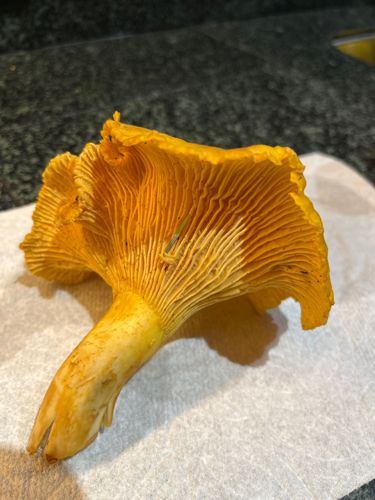
Physical Characteristics
Cap: Typically golden yellow to orange, irregularly shaped with wavy margins, often depressed in the center. Gills: Not true gills, but rather blunt, vein-like ridges or folds that run down the stem (decurrent), often forked and cross-veined, same color as the cap. Stem: Solid, tapering downwards, often lighter in color than the cap, smooth. Spore print: Pale cream to yellowish. Size: Caps usually 2-10 cm across, stems 2-6 cm long.
Habitat & Growing Conditions
Typically found growing on the ground in mossy areas or among leaves in deciduous or coniferous forests, often associated with oak, spruce, fir, and birch trees. They form mycorrhizal relationships with trees.
Season & Fruiting Time
Late spring through fall, depending on region and rainfall. Often appears after summer rains.
Similar Looking Species
Look-alikes include the False Chanterelle (Hygrophoropsis aurantiaca), which has true, thin, blade-like gills that are more orange, and the Jack O'Lantern mushroom (Omphalotus illudens), which grows in dense clusters on wood, has true gills, and is often bioluminescent. The Pacific Golden Chanterelle (Cantharellus formosus) and Smooth Chanterelle (Cantharellus lateritius) are also closely related and similar in appearance.
Ecological Role
Mycorrhizal, forming a symbiotic relationship with trees. The fungus helps the host tree absorb water and nutrients, and in return, the tree provides the fungus with sugars produced through photosynthesis.
Safety reminder
AI mushroom identification is a best-effort estimate and can be wrong. Never use it to decide whether a mushroom is safe to handle or eat — always confirm with a qualified mycologist before any consumption.
Identified on: 12/10/2025
Mode: Standard