Boletus
Boletus sp.
Type: Boletes
Physical Characteristics
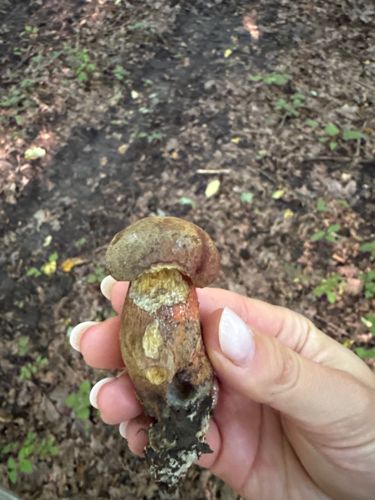
This particular mushroom appears to be a bolete due to its spongy pore layer instead of gills under the cap. The cap is somewhat rounded and brownish. The stem is robust, likely bulbous or club-shaped, and shows bruising, possibly blueing or darkening, especially towards the base which is discolored and appears to have dirt and debris clinging to it. The flesh might be pale, but some areas show yellowish tints, and there are visible insect or slug trails on the stem.
Habitat & Growing Conditions
Based on the background, the habitat appears to be a woodland or forest floor with leaf litter and soil. Boletes typically grow terrestrially (on the ground) in association with various tree species, including conifers and hardwoods. The specific tree association depends on the particular species of bolete.
Season & Fruiting Time
Boletes are generally found during the summer and fall months, typically after periods of rain, when conditions are suitable for fruiting. Their appearance can vary geographically.
Similar Looking Species
Many bolete species share similar characteristics. Distinguishing features often include the color and texture of the cap, the color of the pore surface, the presence and nature of netting or reticulation on the stem, color changes when bruised or cut, and spore print color. Without more specific details or a clearer view of certain features (like the pore surface color), pinpointing a precise species is difficult. Some general look-alikes could be other species within the Boletus genus or related genera like Suillus or Tylopilus, which also have pores. The dark bruising at the base might suggest a blue-staining species.
Ecological Role
This mushroom is likely mycorrhizal, forming a symbiotic relationship with the roots of trees. In this relationship, the fungus helps the tree absorb water and nutrients from the soil, while the tree provides the fungus with sugars produced through photosynthesis. This interaction is crucial for the health and growth of many forest ecosystems.
Safety reminder
AI mushroom identification is a best-effort estimate and can be wrong. Never use it to decide whether a mushroom is safe to handle or eat — always confirm with a qualified mycologist before any consumption.
Identified on: 7/31/2025
Mode: Standard