Brittlestem
Psathyrella (likely a species within this genus, precise identification without microscopic features is difficult)
Type: gilled mushroom
Physical Characteristics
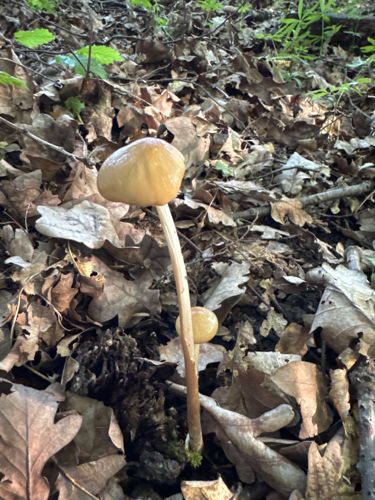
The image likely depicts a species of Psathyrella due to its overall appearance. The cap appears conical to campanulate (bell-shaped) and is a yellowish-brown or tawny color, with a smooth, somewhat moist or hygrophanous (changing color depending on hydration) surface. The gills are not clearly visible but would typically be adnate to adnexed and become darker with age due to spore development. The stem is thin, elongated, and appears to be somewhat translucent to pale in color, possibly with a slightly fibrous or fragile texture. The base of the stem is rooted in the substrate, possibly from decaying wood.
Habitat & Growing Conditions
Psathyrella species commonly grow on decaying wood (logs, stumps, buried wood), wood chips, or rich, organic soil. They are found in various wooded habitats, including deciduous and coniferous forests, as well as disturbed areas and gardens where woody debris is present. The mushroom in the image appears to be growing from decaying material on the forest floor, likely buried wood or leaf litter.
Season & Fruiting Time
Most Psathyrella species fruit from spring through autumn, depending on the specific species and region. They typically appear after periods of rain, as moisture is essential for their growth.
Similar Looking Species
Many species within the genus Psathyrella look similar to each other, making species-level identification challenging without microscopic examination and spore analysis. Other genera that might be superficially similar include some species of Mycena or Galerina, but these generally differ in gill attachment, cap shape variation, or growth habit. Distinguishing features often involve spore color (Psathyrellas have dark brown to purplish-brown spores), the presence or absence of a veil remnant, and microscopic cap cuticle structures.
Ecological Role
Psathyrella species are primarily saprophytic, meaning they obtain nutrients from decaying organic matter. They play a crucial role in breaking down dead wood and plant material, recycling nutrients back into the ecosystem. This contributes to soil health and nutrient cycling in forests and woodlands.
Safety reminder
AI mushroom identification is a best-effort estimate and can be wrong. Never use it to decide whether a mushroom is safe to handle or eat — always confirm with a qualified mycologist before any consumption.
Identified on: 7/31/2025
Mode: Standard