Brittlegill
Russula species
Type: gilled mushroom
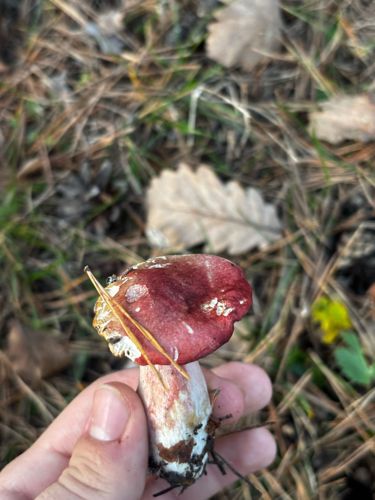
Physical Characteristics
The mushroom in the image appears to be a Russula species due to its brittle, often brightly colored cap and lack of a universal or partial veil. The cap is depresses, dark red to purplish with whitish spots, while the stipe is white with reddish or brownish stains, particularly towards the base. This staining could be due to handling and also suggest the presence of iron salts in the substrate. Russula species characteristically have white, brittle gills and a granular stipe texture. The cap cuticle is often peelable to varying degrees.
Habitat & Growing Conditions
Russula species are commonly found growing terrestrially in mycorrhizal association with various tree species, including conifers (like pines evident in the background) and deciduous trees (like oaks, also suggested by leaves in the background). They typically prefer well-drained, acidic to neutral soils in woodlands and forests.
Season & Fruiting Time
Most Russula species fruit from late summer through autumn, depending on the specific species and geographical location. Favorable conditions include warm temperatures and sufficient moisture after rainfall.
Similar Looking Species
There are many Russula species, and distinguishing them often requires microscopic examination or careful noting of subtle features like cap color variations, gill spacing, taste (some are acrid, some mild - *do not consume*), and spore print color. They can be confused with some Lactarius species (milkcaps), but Russula lack the latex (milk) that Lactarius exude when cut or damaged. The variability within the Russula genus makes precise identification challenging without additional information and macroscopic/microscopic examination of the specimen.
Ecological Role
Russula species are primarily mycorrhizal, forming symbiotic relationships with the roots of trees. They help their host trees absorb water and nutrients (especially phosphorus and nitrogen) from the soil, in exchange for sugars produced by the tree through photosynthesis. This makes them crucial components of forest ecosystems.
Safety reminder
AI mushroom identification is a best-effort estimate and can be wrong. Never use it to decide whether a mushroom is safe to handle or eat — always confirm with a qualified mycologist before any consumption.
Identified on: 7/22/2025
Mode: Standard