Tinder Fungus, Hoof Fungus, or False Tinder Conk
Fomes fomentarius
Type: polypore
Physical Characteristics
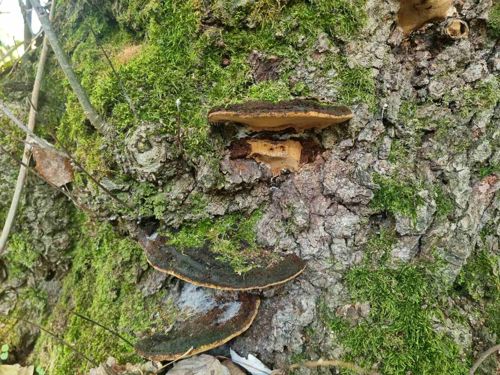
The Fomes fomentarius, commonly known as Tinder Fungus, Hoof Fungus, or False Tinder Conk, presents as a hoof-shaped or shelf-like woody bracket fungus without a stem, directly attached to its host. The upper surface of the cap is typically concentrically zoned, varying in color from light gray or whitish to brown or blackish, often with a tough, protective crust. The underside features a poroid surface, cream to brownish in color, with very small pores. The flesh is tough and corky. The size can range significantly, from 5-40 cm (2-16 inches) wide and up to 20 cm (8 inches) thick.
Habitat & Growing Conditions
This fungus is a common wood-decaying organism, primarily found on dead or dying hardwood trees, particularly birch, beech, and maple. It is a parasitic fungus that causes white rot in the heartwood of living trees, eventually continuing to decompose the wood after the tree has died. It grows directly on the trunk or large branches.
Season & Fruiting Time
Fomes fomentarius is perennial, meaning it can be found year-round. Its fruiting bodies are persistent and can last for many years, adding new layers of growth annually.
Similar Looking Species
Similar looking species include other bracket fungi or polypores. For example, the Artist's Conk (Ganoderma applanatum) has a flatter cap and its pore surface bruises dark when scratched, unlike Fomes fomentarius. The Red-banded Polypore (Fomitopsis pinicola) often has a reddish band near the margin and grows on both hardwoods and conifers. Distinguishing features include the specific cap coloration, zoning patterns, pore surface characteristics, and the type of wood it grows on.
Ecological Role
Fomes fomentarius is a white-rot fungus, playing a crucial ecological role as a decomposer. It breaks down cellulose and lignin in wood, contributing to nutrient cycling in forest ecosystems. As a parasite, it attacks weakened or damaged trees, which can accelerate the natural selection process within a forest by removing less vigorous individuals. After the host tree dies, it continues its saprophytic role in decomposing the dead wood.
Safety reminder
AI mushroom identification is a best-effort estimate and can be wrong. Never use it to decide whether a mushroom is safe to handle or eat — always confirm with a qualified mycologist before any consumption.
Identified on: 11/3/2025
Mode: Standard