Amber Jelly Roll
Exidia recisa
Also called amber jelly, willow brain, brown jelly roll
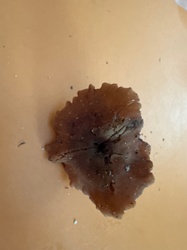
A translucent amber to tawny-brown jelly forming top-shaped blobs hanging from dead willow twigs, each narrowed to a small point of attachment.
Overview
Amber Jelly Roll (Exidia recisa) is a warm-coloured jelly fungus that hangs from dead attached twigs, particularly willow, as clusters of translucent amber to tawny-brown lobes. Each fruiting body is broadest at the top and tapers to a narrow attachment point, giving it a spinning-top or short-stalked appearance that is unusual within the genus.
Held up to the light, fresh material is beautifully clear, the colour of dark honey or weak tea, with the twig visible through the thinner parts. As it dries the jelly contracts into a small, hard, dark reddish-brown to almost black nodule clinging to the bark, and it will rehydrate to full size after the next rain.
The species is one of several smooth-surfaced Exidia species that contrast with the warty Black Witch's Butter. In North America, much material passing under this name belongs to the closely related Exidia crenata, which behaves similarly but is more often found on oak; the two are separated with difficulty in the field.
How to identify it
Fruiting body
Top-shaped, wedge-shaped or shallowly cup-like gelatinous bodies 1–3 cm across, borne in groups along a twig and sometimes fusing into short rows. The upper or outer face is broad and often shallowly folded or wrinkled; the base narrows abruptly to a small point of attachment, so that hydrated fruiting bodies appear to dangle from the wood.
Surface
Smooth and glistening, without the dark pimples of Exidia glandulosa. Wrinkles and folds may develop on the fertile face as the body expands, but these are broad creases rather than granular warts.
Colour
Amber, tawny, reddish-brown or honey-brown, translucent when fully hydrated so that light passes through the tissue. Darkening to reddish-black on drying and shrinking to a small hard lump.
Flesh and spore print
Flesh gelatinous, elastic and slightly firm, translucent throughout, with no fibrous core, ring, volva or true stipe, and no bruising colour change. Spore print white.
Where and when it grows
Amber Jelly Roll grows on dead branches and twigs that are still attached to the tree, with willow the classic substrate; poplar, hazel, oak, ash and other broadleaved trees are also used. Damp riverside willow carr, wet woodland edges and hedgerows are especially productive.
It fruits from autumn through winter into early spring, being one of the group of jellies most visible during the leafless months when dead twigs are easy to inspect. The species is widespread in temperate Europe and Asia, and closely related species occupy the same niche in North America.
Ecological role
Exidia recisa is a saprotrophic decomposer of dead hardwood, producing white rot in the small-diameter twig and branch wood it colonises. The mycelium establishes in twigs that have died back in the crown and fruits through the bark once conditions turn consistently wet.
The narrow attachment and pendulous form may help rainwater drain from the fertile surface while keeping the body hydrated. As in other Exidia, the gelatinous tissue tolerates repeated desiccation and freezing, allowing the same fruiting bodies to release spores intermittently over a period of weeks or months rather than in a single flush.
Similar species
Exidia glandulosa (Black Witch's Butter) is much darker, olive-black rather than amber, and its fertile surface is studded with minute dark warts. Exidia crenata is essentially identical in shape and colour and is separated mainly by substrate preference and microscopic detail, making the host tree worth recording.
Auricularia auricula-judae (Jelly Ear) is brown and gelatinous but forms much larger, distinctly ear-shaped cups with a veined inner face and a minutely downy outer face, usually on elder. Tremella mesenterica is a purer yellow and forms crowded folded brains rather than discrete top-shaped lobes on narrow bases.
Common questions about Amber Jelly Roll
What shape should I look for?
Which trees produce it most often?
How do I separate it from Black Witch's Butter?
When is the best time to look?
Amber Jelly Roll found by the community
Photos submitted through the app and matched to this entry.