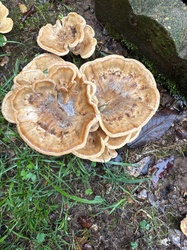
Black-staining Polypore
Meripilus sumstinei
Also called blackening polypore, sumstine's polypore
A large clustered rosette of grey-brown fans at the foot of hardwood trees whose white pore surface and pale flesh blacken within minutes of being touched.
Overview
Meripilus sumstinei is the North American representative of a small genus of large, clustered, ground-level polypores defined by one dramatic character: every part of the fruiting body stains black where it is handled, cut or damaged. A specimen that was uniformly pale in the morning is often patterned with sooty fingerprints and dark margins by the afternoon.
The fruiting body is a compound rosette. Numerous overlapping fan-shaped caps arise from a shared, short, thick base, together forming a mass 20–70 cm across at the foot of a tree. Individual caps are thin and flexible compared with the thick tough fans of Bondarzewia, and the pore surface is fine rather than coarse.
For many years North American collections were filed under the European Meripilus giganteus, and the two are extremely similar. They are now treated as separate species on molecular and geographic grounds, with M. sumstinei the eastern North American taxon typically found on oak.
How to identify it
Cap
Caps are fan- to spoon-shaped, 5–20 cm wide, thin and pliable, with a finely radially wrinkled or streaked surface and a wavy, often torn margin. Colour ranges from grey-brown and smoky tan to olive-brown, usually with concentric shading and darker, blackened patches wherever the surface has been touched. Many caps overlap to form a dense rosette.
Pores
The pore surface is white to cream and very finely porose — pores are minute, roughly 3–5 per millimetre, so the underside looks almost smooth to the naked eye. It bruises grey then black within a few minutes, and the tube layer is shallow and decurrent onto the base.
Stipe
No distinct stipe; the caps converge on a short, thick, often buried common base attached to a root or the root collar, so the rosette usually appears to sit directly on the soil.
Flesh & spore print
The context is white, soft and fibrous when young, becoming tougher and more leathery with age, and it too darkens to grey-black on exposure. The blackening reaction across cap, pores and flesh together is diagnostic. The spore deposit is white.
Where and when it grows
Black-staining Polypore fruits at the base of living and dead hardwoods and on stumps, arising from roots and the root collar. Oak is the commonest support, with beech, maple and other broadleaf trees also used. It is a fungus of mature deciduous woodland, wooded parks, and old street and garden trees.
Its range covers eastern and central North America, from southern Canada and New England south to the Gulf coast and west to the prairie edge. Fruiting occurs from midsummer into early autumn following substantial rain, and a colonised root system may fruit repeatedly in the same spot over several years.
Ecological role
The fungus causes a white rot of the roots and butt of its supporting tree, breaking down lignin and cellulose and leaving the affected wood pale, soft and stringy. It functions as a parasite on living root and butt tissue and then as a saprotroph on the dead stump, and because the decay is hidden below ground, a large rosette is often the first outward sign that a tree's root plate has been compromised.
Root and butt rot of this kind contributes substantially to tree failure in mature stands and in urban tree populations, creating canopy gaps and adding coarse woody debris to the forest floor. The soft, short-lived rosettes decay quickly once past their peak and are heavily used by fly larvae, beetles and slugs, returning nutrients rapidly to the soil.
Similar species
Meripilus giganteus is essentially the European counterpart, matching it in form and in the blackening reaction, but is centred on beech in Europe rather than oak in eastern North America; range and support tree are the practical separators. Grifola frondosa forms a similar-sized cluster at the base of oaks but has smaller, more numerous grey-brown tongues on a distinctly branched pale stalk system and does not blacken when handled.
Bondarzewia berkeleyi shares the basal rosette habit but has much thicker, tougher cream-tan fans with large, coarse, angular pores and shows no staining reaction. Laetiporus cincinnatus is salmon-orange with a fine white pore surface and soft non-staining flesh, and Polyporus umbellatus has many small circular caps each on its own central stalk.
Common questions about Black-staining Polypore
How fast does the blackening appear?
How is it different from Hen of the Woods?
Where should I look for it?
Is it the same as the European Giant Polypore?
Guides
Black-staining Polypore found by the community
Photos submitted through the app and matched to this entry.