Identification guide
Black-staining Polypore Identification Guide
A field walkthrough for recognising Meripilus sumstinei, the huge grey-brown rosette polypore at the base of hardwoods whose white pore surface blackens under a fingernail.
The Setting and the First Impression
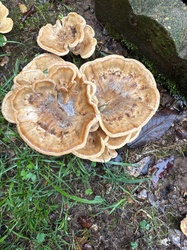
You usually meet this fungus before you have decided to look for it. Walking a mature hardwood woodland in late summer, you round the buttress of a big oak and there is a grey-brown mass the size of a cushion sprawled against the trunk flare. From ten paces it reads as a shaggy cabbage, or as a pile of overlapping grey shingles pushed up out of the leaf litter. Nothing about the first impression is mushroom-shaped: there is no obvious stalk, no cap-and-stem silhouette, just a compound rosette of fan-shaped lobes radiating from one point.
The habitat is half the identification. Meripilus sumstinei grows from the root system and butt of living or recently dead broadleaf trees, overwhelmingly oaks, with beech, maple and other hardwoods next in line. Sometimes the connection is obvious and the rosette is clamped to the base of a standing trunk. Just as often the clump sits in grass or litter a metre or two out from the trunk, apparently terrestrial, because it is fruiting from a buried lateral root. If you find something that looks right but seems to be growing from soil, probe gently at the base with a finger and you will normally find woody tissue.
Working Through the Fruiting Body
Start with the overall architecture. A mature clump is 20 to 60 cm across and occasionally much larger, and it is built from a short, thick, branched common base out of which the individual lobes arise. Count the lobes: this species tends to produce relatively few, relatively broad ones, each 5 to 15 cm wide and spoon-shaped, spatulate or fan-shaped, attached along one side rather than at a central point.
Read the upper surface next. It is dry, matt and finely radially fibrillose, sometimes minutely scurfy or roughened near the point of attachment, and it often shows faint concentric zoning that is more a matter of texture than of strong colour bands. The colour range is buff, tan, smoky grey-brown and olive-brown. Crucially, watch what happens where the surface has been rubbed, insect-grazed or bumped against a neighbouring lobe: those places darken to grey and then to near-black. On an old clump the whole upper surface has gone charcoal.
The margin of each lobe is thin, wavy and lobed, frequently splitting radially with age. Young margins are paler than the rest of the cap and sometimes almost cream.
The Pore Surface
Turn a lobe over. The spore-bearing surface is poroid, white to cream when fresh, and it runs down the narrowed attachment of the lobe onto the common base, so there is no clean boundary between cap underside and stalk. The pores are small, roughly three to five per millimetre, round to slightly angular, and the tube layer beneath them is shallow, usually only two to five millimetres deep.
Now perform the single most useful test in this guide. Drag a fingernail firmly across the pore surface. Within a minute the bruised line greys, and within five to fifteen minutes it is black. The same happens to cut flesh, to the margin, and to any part you handle repeatedly. This blackening reaction, combined with the rosette habit at the base of a hardwood, is the identification.
Stipe, Base and Flesh
There is no true stipe. Instead there is a stout, whitish to pale tan common base, often partly buried, which branches upward into the lobes. Dig it out carefully and you will see it narrowing into a root or into decayed wood at the tree butt.
Slice a lobe from margin to base. Young flesh is soft, watery and fibrous, white, and it splits into strings when you pull it apart. With age it becomes tougher and more leathery. On the cut face the white surface dulls to grey and then blackens exactly as the pores do, though a little more slowly. Old, weathered clumps are uniformly black, brittle and shrunken, and they persist in that state for weeks, which is why you sometimes find last month's fungus as a black crust at the same tree base.
Taking a Spore Print
Cut a fresh, actively growing lobe with a few centimetres of tube layer attached. Lay it pore-surface-down on a sheet of glass or on paper, and because the print is white, use black paper or dark glass so you can see it. Cover the piece with an upturned bowl to hold humidity, and leave it six to twelve hours at room temperature. The deposit is white to very pale cream. Under a lens the spores are broadly elliptical to nearly round and smooth. A white print rules out a large group of brown-spored bracket fungi and is consistent with the polypore family this species belongs to.
Substrate and Season
The fungus behaves as a butt-rot and root-rot organism on hardwoods, taking apart the lower trunk and major roots. It fruits from midsummer through autumn in temperate broadleaf forest, parks and old shade trees, and it comes back to the same tree year after year until the root system is exhausted. Finding a spot where a blackened clump rotted last season is a good reason to check the same buttress the following August.
Separating It From Look-alikes on Morphology
Hen of the woods, Grifola frondosa. The closest confusion. Grifola builds its rosette from many more, much smaller, more spoon-shaped or tongue-shaped caps, each typically two to seven centimetres wide and thinner in section, on a conspicuously branched pale stalk system. Its pore surface stays white and does not blacken when scratched. If a fingernail line goes grey and then black, you are not looking at Grifola.
Bondarzewia berkeleyi. Also a large rosette at the base of oaks. It is paler, cream to buff rather than grey-brown, considerably thicker and tougher in section, and its pores are visibly larger, roughly one to two per millimetre, often irregular and somewhat tooth-like near the margin. It does not blacken.
Laetiporus species. Bright orange to salmon above with a yellow to white pore surface, arranged in shelving brackets rather than a rosette from a common base, and with no darkening reaction.
Polyporus umbellatus. Made of many small, circular, centrally stalked caplets on a much-branched base, so each unit has a navel-like depression in the middle rather than a lateral attachment. No blackening.
Meripilus giganteus. The Old World counterpart with essentially the same growth habit and the same blackening. In practice the two are separated by geography, host and spore measurements rather than by anything visible in the hand.
Quick Field Checklist
Rosette of a few broad, fan-shaped grey-brown lobes; common branched base at the butt or root of a hardwood; white pore surface with small pores running down the base; grey-to-black bruising on pores, margin and cut flesh; white spore print; summer to autumn.
Common questions
What is the single most reliable field character for the Black-staining Polypore?
Why does it sometimes appear to be growing straight out of the ground?
Which trees does it associate with, and at what time of year?
How do I tell it apart from hen of the woods without cutting anything?
Full reference entry for Black-staining Polypore
Cap and fruiting body, spore print colour, substrate, season, ecological role and the species most often confused with it.
Open the Black-staining Polypore entry →