
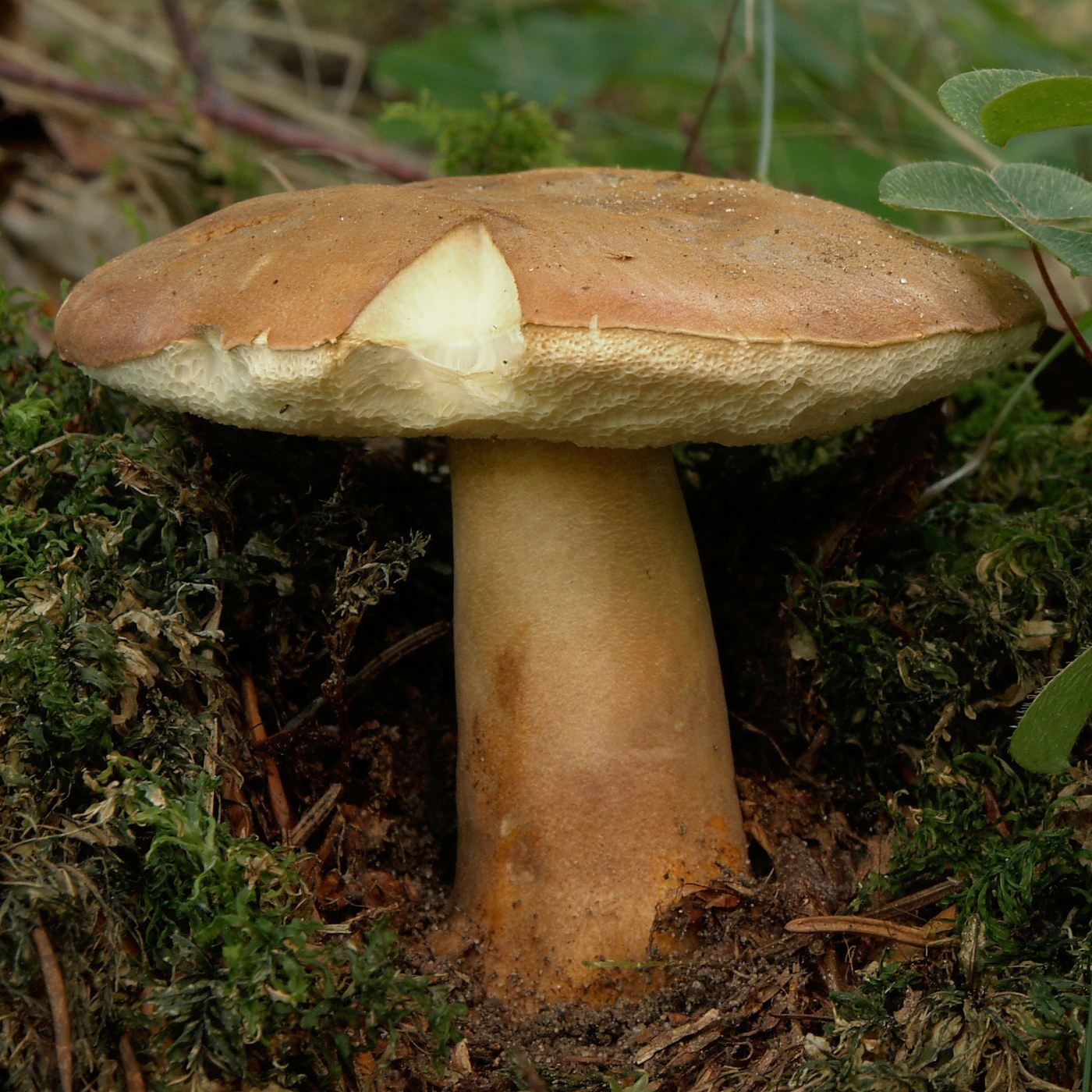
Chestnut Bolete
Gyroporus castaneus
Also called chestnut gyroporus
A neat, rusty chestnut bolete with white to pale yellow pores, brittle flesh and a hollow, chambered stipe, and a pale straw spore print unusual for the group.
- Group
- Boletes
- Cap
- Rich chestnut brown, dry, matt and suede-like
- Spore print
- Pale straw yellow
- Habitat
- Sandy soils under oak, beech and chestnut
- Season
- Summer to autumn
Overview
The Chestnut Bolete is a compact, warmly coloured bolete of dry sandy woodland, easily identified by the rich rust-chestnut hue of both cap and stipe, the crisp white pores beneath, and the surprise of a stipe that proves hollow when snapped.
It belongs to Gyroporus, a small genus placed in its own family, the Gyroporaceae, some distance from the main boletes. All Gyroporus species share brittle rather than fibrous flesh, a stipe that becomes stuffed with cottony chambers and then hollow, and a pale straw-yellow spore print instead of the olive-brown of most of the order.
Because it is small, tidy and rarely maggot-riddled, it is a satisfying species to find, and it is a reliable indicator of light, free-draining soils under old broadleaves.
How to identify it
Cap
Convex then flat, 3–10 cm across, with a margin that is often slightly incurved and sometimes minutely fringed. The surface is dry and matt with a fine suede or kid-leather texture, occasionally cracking in old or drought-stressed specimens, and coloured a uniform rich chestnut, rusty tan or cinnamon-brown.
Pores
Small and round, white at first, ageing to cream and finally pale straw or lemon yellow. They stain dull brownish where bruised and never blue. The tube layer is short, whitish to pale yellow, and typically depressed around the stipe apex.
Stipe
Cylindrical or slightly swollen below, 3–8 cm tall and often rather short relative to the cap, coloured like the cap or a little paler. The surface is dry and matt without net, dots or scabers. Internally the stipe is first stuffed with a cottony pith, then develops irregular chambers and finally becomes hollow; snapping it produces a clean, brittle break rather than a fibrous tear.
Flesh and spore print
White, brittle and unchanging when cut, or very rarely acquiring a faint brownish tint. The spore print is pale straw to lemon yellow, quite unlike the olive-brown of Boletus and its allies.
Where and when it grows
Gyroporus castaneus is mycorrhizal with broadleaves, most commonly oak, beech and sweet chestnut, and it strongly favours light, sandy or gravelly, well-drained and usually acid soils. It appears on woodland banks, path edges, heathy oak woodland and warm, open glades, often in small scattered groups.
The season runs from July into October. The species is widespread across Europe, in eastern North America and in temperate Asia, though several look-alike taxa are now recognised within what was once treated as a single worldwide species.
Ecological role
This is an ectomycorrhizal fungus that colonises the fine roots of its oak or beech partner, extending hyphae through sandy soils that are typically low in available nutrients and prone to drying out. In such habitats the mycorrhizal sheath contributes substantially to the tree's phosphorus supply and to its ability to draw water from a large volume of loose substrate.
The fruit bodies are small and comparatively short-lived, and the brittle, hollow stipe means they collapse and dry quickly, releasing spores over a few days. Its distinctive pale-spored lineage sits near the base of the bolete order, making the genus of particular interest in studies of how mycorrhizal habits evolved in the group.
Similar species
The Bluing Bolete (Gyroporus cyanescens) is the nearest relative and shares the brittle, hollow stipe, but its cap is pale straw to buff and coarsely fibrillose, and every surface flushes vivid cornflower blue at a touch. Gyroporus purpurinus is smaller with a wine-purple to maroon cap.
Xerocomellus species can look similar in cap colour but have a solid, fibrous stipe, yellow-olive pores that often blue on bruising, and an olive-brown spore print. Aureoboletus and small Suillellus species likewise have solid stipes and olive-brown prints, so snapping the stipe to check for chambers is the fastest way to place a collection in Gyroporus.