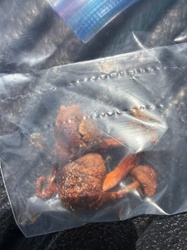
Cortinarius rubellus
Cortinarius rubellus
Also called deadly webcap, pointed webcap
A slender foxy-orange webcap of mossy conifer forest, recognised by its sharply umbonate fibrillose cap, thick widely spaced rusty gills and pale yellow bands on the stipe.
Overview
Cortinarius rubellus is a slim, foxy-orange member of Cortinarius, the webcaps, which by most counts is the largest genus of gilled fungi in the world, with well over a thousand described species in the northern hemisphere alone. Every webcap shares a cobwebby partial veil called a cortina, which stretches like fine silk from the cap margin to the stipe in young fruitbodies and later collapses into a faint fibrillose zone, usually stained rust by falling spores.
Within the genus this species sits in a small group of dry-capped, matt, tawny to orange-brown webcaps of conifer forest. It is set apart by its sharply pointed cap, its unusually thick and widely spaced gills, and the pale yellow fibrillose belts left along the stipe by the outer veil. It has been described more than once under other names, notably Cortinarius speciosissimus and C. orellanoides, both now treated as synonyms.
It is a northern and montane fungus, most abundant in boreal spruce forest and in upland conifer plantations. Fruitbodies push up low among mosses and dwarf shrubs and are easy to walk past, because their modest size and litter-toned colouring blend into the forest floor.
How to identify it
Cap
Usually 3-8 cm across, conical to bell-shaped at first and expanding to broadly convex while keeping a distinctly pointed central umbo. The surface is dry, matt and finely fibrillose to minutely scaly, never slimy or greasy, coloured warm tawny orange-brown to foxy red-brown and often a shade paler and more yellow toward the margin.
Gills
Adnate to narrowly attached, and notably thick, broad and widely spaced. They start ochre-yellow to pale cinnamon and darken through orange-brown to deep rust as spores mature, with edges that stay slightly paler and a little uneven.
Stipe
5-11 cm long and fairly slender, more or less equal or slightly swollen toward the base, pale ochre-yellow to tawny and decorated with irregular yellow fibrillose bands or girdles left by the outer veil. A thin cobwebby cortina is visible in buttons and leaves a rust-dusted fibrillose zone in the upper third.
Flesh & spore print
The flesh is pale ochre to yellowish, tinged tawny in the stipe base, and does not change appreciably when cut. The spore print is rusty brown; under the microscope the spores are large, broadly almond-shaped and coarsely warted.
Where and when it grows
This is strictly a conifer-forest species, partnering Norway spruce and pines and occasionally birch growing on the same ground. It fruits singly or in small scattered troops on damp, mossy, nutrient-poor acid soil, frequently among Sphagnum, feather mosses and bilberry, and turns up along the wet margins of plantation rides and in boggy hollows.
The season runs from late summer into mid autumn, peaking after prolonged rain. Its distribution is northern and upland: common through Scandinavia and the boreal belt, scattered in the mountains of central Europe, local in Scotland, northern England and Wales, and recorded from comparable habitat across northern North America.
Ecological role
Cortinarius rubellus is ectomycorrhizal. Its mycelium sheathes the fine root tips of spruce and pine, forming an outer mantle and an internal Hartig net between the root cells, and through that interface it delivers water, phosphorus and nitrogen scavenged from the litter layer in exchange for sugars made by the tree. On thin, acid, peaty soils this exchange is one of the main routes by which conifers obtain mineral nutrients.
The mycelium is perennial and long lived, creeping slowly through humus and the moss carpet, and fruitbodies appear only when autumn moisture and temperature coincide. Like many webcaps it responds poorly to enrichment and ground disturbance, so its presence tends to indicate undisturbed, unfertilised forest soil.
Similar species
The closest match is Cortinarius orellanus, which is stouter, has a bluntly convex cap rather than a sharply pointed one, lacks the yellow fibrillose girdles on the stipe and grows with broadleaved trees instead of conifers. Cortinarius armillatus is far larger and brick-coloured, with unmistakable cinnabar-red belts around a club-shaped stipe base, and is tied to birch.
Cortinarius gentilis shares the tawny umbonate cap and yellow veil zones but is much more slender, with narrower and more crowded gills and a thin wiry stipe. Small orange Gymnopilus species can match the colour, but they have crowded gills, no cobwebby cortina and a brighter orange-rust spore deposit.
Common questions about Cortinarius rubellus
What is the most distinctive feature of the cap?
Which trees is it associated with?
What colour is the spore print?
How does it differ from Cortinarius orellanus?
Cortinarius rubellus found by the community
Photos submitted through the app and matched to this entry.