Community find
Deadly Cortinar
Cortinarius rubellus
- Group
- gilled mushroom
- Spore print
- Rusty brown or ochre.
- Size
- Cap diameter 3-8 cm; stipe length 5-11 cm, width 0.5-1.5 cm.
- Season
- Late summer to autumn.
- Habitat
- Primarily found in coniferous forests, associated with spruce and pine trees in damp moss.
- Distribution
- Widespread across Europe and parts of North America.
- Key characteristics
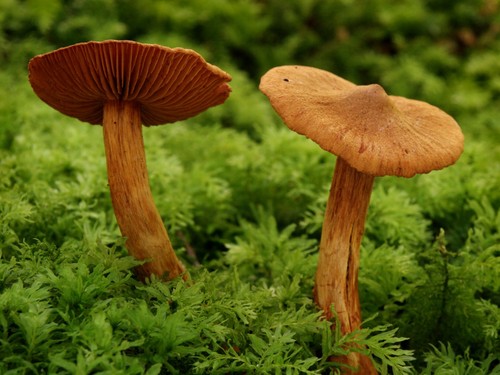
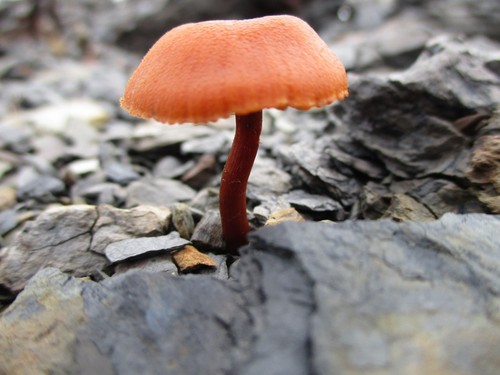
- Rusty brown cap, fibrous conical shape, yellowish-orange gills, and a yellowish-orange stipe with zig-zag banding.
- Fruiting body
- Cap is 3-8 cm, conical to convex with a central umbo, tawny to reddish-brown; gills are thick, distant, and ochre-colored; stipe is 5-11 cm long, often tapered at the base with distinctive yellowish velar bands.
- How to recognise it
- Look for the conical rusty cap, yellowish zig-zag bands on the stem, and the presence of a cortina (cobweb-like veil) in young specimens.
- Look-alikes
- Cortinarius orellanus (lacks the pointed cap), Armillaria species (which have white spore prints), and various other rusty-brown Cortinarius species.
- Ecological role
- Mycorrhizal, forming a symbiotic relationship with coniferous trees.
- Notes
- The genus Cortinarius is one of the largest genera of fungi, containing thousands of species that are often very difficult to distinguish without microscopic analysis.