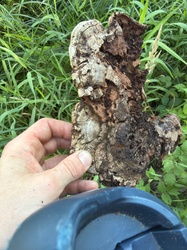
Cracked Cap Polypore
Fulvifomes robiniae
Also called locust polypore, black locust conk, robinia bracket
A hard perennial conk almost restricted to black locust, its blackened upper crust splitting into deep blocky cracks above a rich rusty brown pore surface.
Overview
The Cracked Cap Polypore is the signature bracket fungus of black locust, and its host fidelity is so strong that finding it effectively identifies the tree as well as the fungus. Where black locust has been planted or has naturalised, mature trunks are frequently studded with a vertical series of these hard, blackened conks, sometimes half a dozen or more on a single stem.
It is a member of the Hymenochaetaceae, long placed in Phellinus and now usually treated in Fulvifomes, a genus of perennial, rusty-fleshed, hoof-forming polypores. Like its relatives it grows by adding a new tube layer beneath the previous year's, so a large conk represents many years of accumulated growth and the tree beneath it has been colonised for a long time.
The common name comes from the appearance of the upper surface, which develops a hard black crust that dries and splits into a coarse mosaic of deep, blocky fissures. Against this dark cracked top, the narrow band of bright rusty brown at the growing margin is unusually striking.
How to identify it
Fruit body
The conk is hoof-shaped to broadly cushion-shaped or sometimes shelf-like, 5 to 25 cm wide and up to 15 cm thick, attached broadly and very firmly to the bark. It is woody and rock-hard, and enlarges slowly year on year. Several often occur in a vertical line along one trunk, marking successive infection points.
Upper surface
Young growth is finely velvety and rusty brown, but this quickly gives way to a hard black crust. With age the crust dries and splits into deep, coarse, blocky cracks that divide the surface into irregular plates, the character that names the species. Concentric furrows may be visible under the cracking, and the whole top often becomes dull grey-black and weathered.
Pores
The pore surface is a rich yellowish-brown to rusty brown or tobacco brown, dulling with age but usually retaining warm tones. Pores are minute, roughly 5 to 8 per millimetre, and circular, so the surface appears smooth and matt unless examined with a lens. In section the tubes are arranged in distinct annual layers stacked one beneath the other.
Flesh and spore print
The context is woody and hard, bright yellow-brown to rusty or tawny brown, sometimes faintly zoned, and clearly separated from the black upper crust. It shows no bruising reaction. The spore deposit is pale yellowish to whitish.
Where and when it grows
This polypore is closely tied to black locust, Robinia pseudoacacia, fruiting on the trunks of living trees from old wounds, branch stubs and bark injuries, usually well above the ground rather than at the base. It is occasionally reported from a few other legume trees, but black locust accounts for the great majority of collections.
Being perennial, the conks are present throughout the year, with the fresh rusty growing margin most evident in the warmer months. The species is common in eastern and central North America within the natural range of black locust, and has followed the tree into the many regions where it has been planted or has naturalised, including parts of Europe and Asia. It is found in open woodland, old fields, roadside plantings, shelterbelts, parks and hedgerows wherever mature black locust stands.
Ecological role
Fulvifomes robiniae is a parasite that causes a white rot of the trunk wood of living black locust. The mycelium enters through wounds and spreads within the heartwood, degrading lignin and cellulose so that the central wood becomes pale, soft and eventually hollow. Because black locust heartwood is exceptionally durable and resists most decay organisms, this fungus occupies a specialised niche with little competition, which helps explain both its host fidelity and its abundance.
The hollowing of locust trunks produces cavities widely used by woodpeckers, other hole-nesting birds and small mammals, so heavily conked locust stands are often locally important for wildlife. As a perennial the fungus maintains one fruiting structure for many years, protected by its thick black crust, adding a tube layer each season and releasing spores over a long period. After the tree finally dies the mycelium continues to decay the standing snag and stump.
Similar species
Phellinus igniarius is structurally very similar but grows on willow, birch and alder rather than black locust, and its upper crust is grey-black with finer radial cracking, while its pore surface is more cinnamon to greyish-brown than the warm rusty tones seen here. Fomitiporia robusta is a perennial oak conk, more cushion-shaped, with a less deeply and less blockily cracked surface.
Fomes fomentarius has a smooth, evenly banded grey hoof without deep cracking and a pale grey-brown pore surface. Ganoderma applanatum is flatter and shelf-like with a thin dull brown crust and a white pore surface that bruises brown at a scratch, a reaction that does not occur in this species. The combination of black locust as the tree, a deeply block-cracked black crust, and a rusty brown pore surface with minute pores is diagnostic.
Common questions about Cracked Cap Polypore
What causes the cracked appearance?
Does it grow on trees other than black locust?
Why are there so many conks on one trunk?
How do I confirm it is perennial rather than annual?
Cracked Cap Polypore found by the community
Photos submitted through the app and matched to this entry.