Enoki
Flammulina velutipes
Also called enokitake, velvet shank, winter mushroom, golden needle mushroom, velvet foot
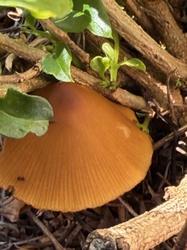
A cold-weather wood-rotter forming dense tufts of small, glossy tawny caps above dark velvety stems. Cultivated strains grown in darkness look completely different: long, pale, thread-thin stems with tiny white caps.
Overview
Enoki, Flammulina velutipes, is one of the few gilled fungi that fruits through frost. In the wild it appears as crowded clusters of small, varnished orange to tawny-brown caps on dead hardwood, each cap raised on a slender stipe whose lower half is coated in dark brown to blackish velvet — the feature behind both the scientific epithet velutipes ('velvet-footed') and the English name Velvet Shank.
The cultivated form looks so unlike the wild one that people rarely connect them. Grown in bottles in darkness and elevated carbon dioxide, the mycelium produces bundles of long, ivory-white, wire-thin stems topped by caps only a few millimetres across. Light and normal air are what produce the wild shape and colour; the fungus is the same organism, and East Asian cultivated strains are now often treated as the closely related Flammulina filiformis.
Flammulina belongs to the Physalacriaceae, alongside the honey fungi, and shares with them a wood-decaying habit and white spores — but not their black bootlace rhizomorphs or their ring.
How to identify it
Cap
Caps are small, 2–7 cm across, convex at first and flattening with age, sometimes with a shallow central hump. The surface is distinctly sticky or greasy when damp and glossy when dry, coloured deep orange-brown or tawny at the centre and fading to yellow-ochre or honey at the margin. Older caps become wavy and slightly translucent-striate at the edge.
Gills
The gills are white to pale creamy-yellow, moderately spaced, fairly broad, and attached to the stipe by a narrow adnexed connection — they neither run down the stem nor stand completely free. With age they may develop faint rusty spotting from bruising, but the underlying colour stays pale.
Stipe
The stipe, 3–8 cm long and only 3–8 mm thick, is tough and cartilaginous, often curved where clustered caps have jostled. It is yellowish and smooth in the upper part and covered from the middle downwards in a dense, short, dark brown to nearly black velvety pile. There is no ring at any stage. Stipes of a cluster are typically fused at the very base.
Flesh and spore print
The flesh is thin, whitish to pale yellow in the cap and much tougher and browner in the stipe, with no colour change on cutting and a mild odour. The spore print is white — an important contrast with the rusty-brown prints of superficially similar wood-dwelling species.
Where and when it grows
Flammulina velutipes grows in tufts and tiered clusters on dead and dying deciduous wood: standing dead trunks, fallen logs, stumps and the wounds of living trees. Elm was historically its classic host, with willow, poplar, ash, beech and oak also frequent; it appears in woodland, hedgerows, riverbanks, parks and gardens. Fruiting bodies emerge from bark crevices, old pruning cuts and stump surfaces, often reappearing in the same spot for several seasons.
Its season is the opposite of most gilled fungi. Fruiting begins in late autumn and continues through winter, peaking in mild spells between frosts and often carrying on into early spring; caps can freeze solid and resume growth when they thaw. The species is widespread across temperate Europe, Asia and North America, and cultivated forms are grown indoors year-round on sterilised sawdust and bran substrate.
Ecological role
The fungus is a saprotroph and weak parasite that causes a white rot: its enzymes degrade lignin as well as cellulose, leaving the decayed wood pale, soft and fibrous. It commonly begins in wounded or stressed living trees, colonising heartwood and dead branch stubs, then continues to break the timber down long after the tree has fallen, so a single trunk may fruit for many consecutive winters.
Cold tolerance is its ecological signature. Antifreeze-active proteins in the fruiting body allow growth and spore release at temperatures near or below freezing, when competing wood-decay fungi are dormant and insect grazing is minimal. Spores dispersed in winter wind land on fresh frost cracks and pruning wounds, where the mycelium establishes with little competition.
Similar species
Galerina marginata is the most frequent confusion among small tawny clustered wood-dwellers. It is separated by a rusty-brown spore print (against white in Enoki), a distinct membranous ring or ring-zone on the stipe, browning gills, and a stipe that is finely silky-fibrillose rather than velvety-black below. Kuehneromyces mutabilis, the Sheathed Woodtuft, also gives a brown spore print and has a two-tone hygrophanous cap that dries pale from the centre outward, plus a ragged scaly stipe beneath a clear ring zone.
The honey fungi (Armillaria species) share white spores and clustered growth on wood but are far larger, have a woolly ring on the stipe, dry finely scaly caps, and produce black rhizomorphs under the bark. Small orange Xeromphalina and Gymnopus species on conifer debris are more slender, lack the sticky varnished cap surface, and never develop the black velvety stipe base that instantly identifies Flammulina.
Common questions about Enoki
Why does cultivated enoki look nothing like the wild mushroom?
What is the velvet foot?
When and where should I look for it?
What spore print colour does it give?
Enoki found by the community
Photos submitted through the app and matched to this entry.