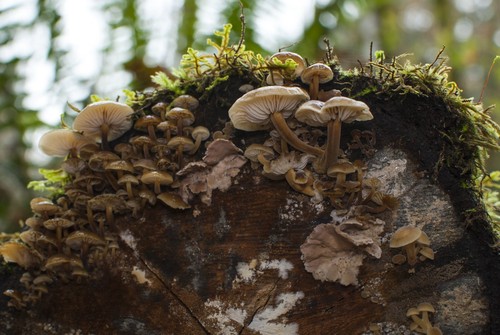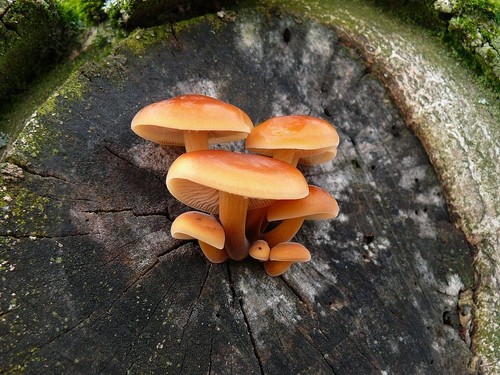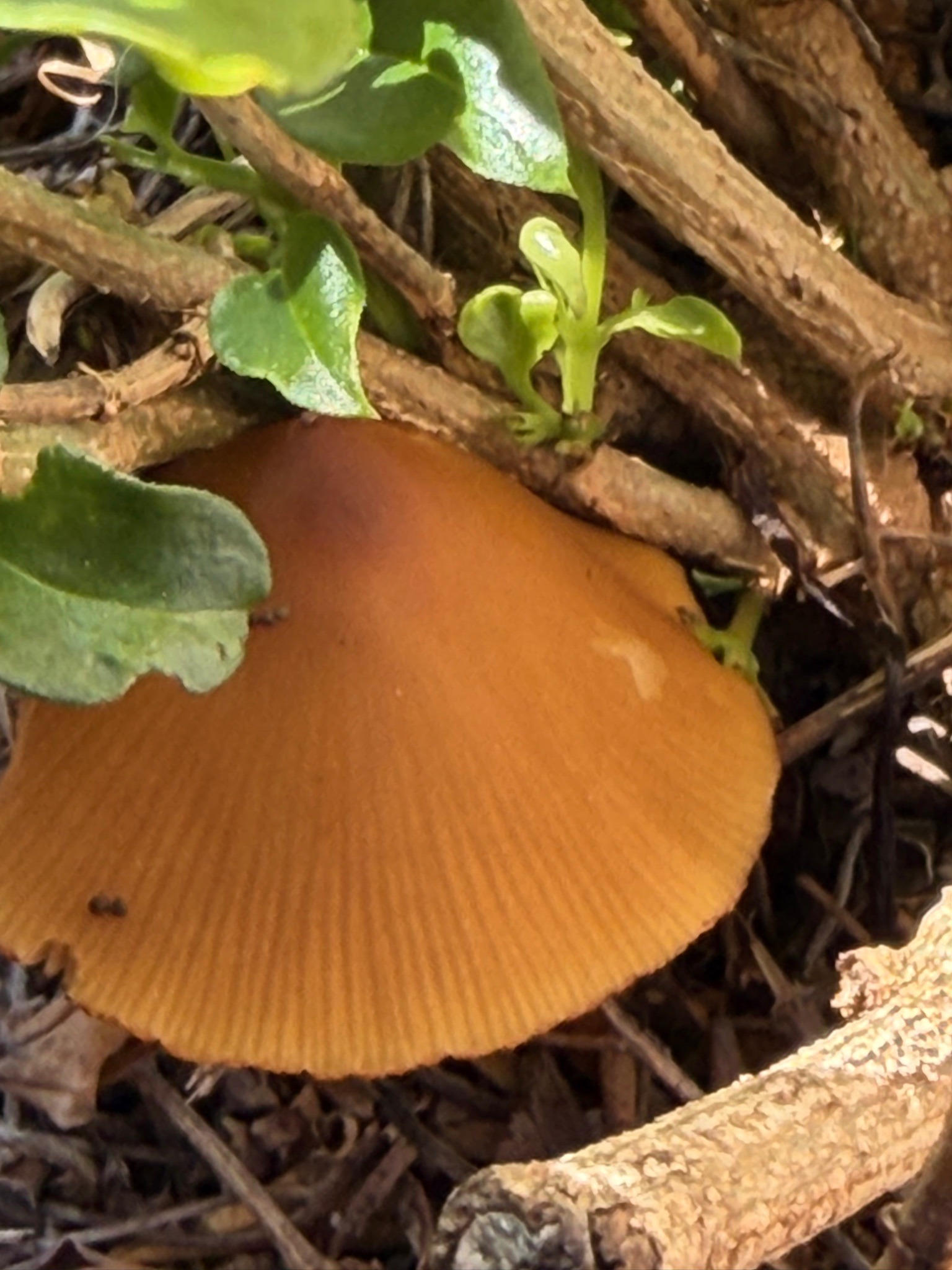
Community find
Velvet Foot (Enoki)
Flammulina velutipes
- Group
- gilled mushroom
- Spore print
- White
- Size
- Cap diameter: 2-7 cm; Stipe: 2-10 cm long, 3-10 mm thick.
- Season
- Widely known for its ability to fruit in cold weather, commonly found in late autumn, winter, and early spring.
- Habitat
- Grows in clusters on dead or dying deciduous wood, particularly stumps and logs of hardwood trees like elms and willows.
- Distribution
- Common throughout the Northern Hemisphere, including North America, Europe, and Asia.
- Key characteristics
- Orange-brown, smooth cap with a sticky or slimy surface when wet. The cap often features distinct striations along the margin. It typically has a dark, velvety stipe (stem).
- Fruiting body
- Cap is convex to flat, 2-7 cm wide, yellow-orange to reddish-brown, darker in the center, viscid. Gills are adnexed to nearly free, white to pale yellow. Stipe is 2-10 cm long, tough, covered in fine dark brown or blackish velvety hairs starting from the base.
- How to recognise it
- Look for a dark, velvety stem and a white spore print. The ability to fruit during frost or after a winter thaw is a major diagnostic feature.
- Look-alikes
- Galerina marginata (Funeral Bell) which has a ring on the stipe and brown spores, and Omphalotus illudens (Jack-o'-lantern) which is larger and fruits earlier.
- Ecological role
- Saprophytic (decomposing dead wood) and occasionally parasitic on living trees.
- Notes
- This species is the wild version of the cultivated Enoki mushroom. In nature, it looks very different (larger, darker, and sturdier) than the long, white, spindly cultivated stalks which are grown in the dark with elevated carbon dioxide levels.