
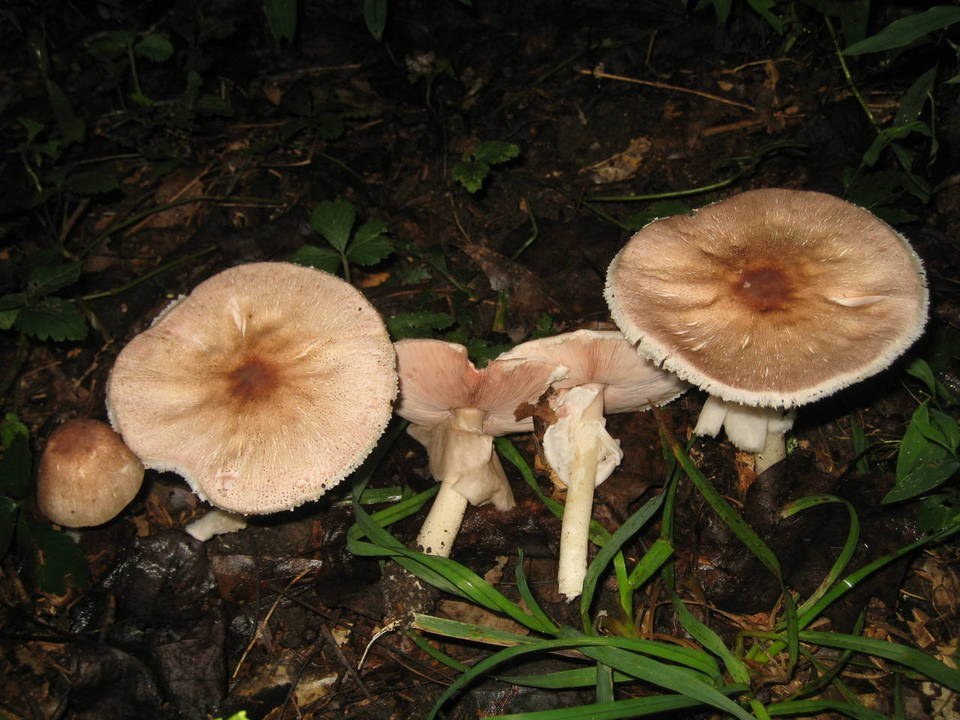
Flat-topped Agaricus
Agaricus placomyces
Also called eastern flat-top agaricus, placomyces agaricus
A North American woodland Agaricus with a characteristically flat-topped, grey-scaled cap, a bulbous stipe base that flushes chrome-yellow and a sharp inky odour.
- Group
- Gilled
- Cap
- Flattened whitish cap with grey-brown scales
- Spore print
- Dark chocolate brown
- Habitat
- Woodland soil and litter, eastern North America
- Season
- Summer to autumn
Overview
Flat-topped Agaricus (Agaricus placomyces) is the North American representative of the grey-scaled, yellow-staining section of the genus. Its common name captures its most obvious profile character: the cap expands to a distinctly flattened, sometimes almost table-like shape rather than remaining domed, with the dark scales crowded over a broad flat disc.
The species sits alongside Agaricus moelleri and Agaricus hondensis in a group united by three linked features — fine dark grey-brown fibrillose scales over a pale ground, a bulbous stipe base that stains bright chrome-yellow when cut, and a sharp inky or phenolic odour. All also show the standard genus signature of free gills passing from pale through pink to chocolate brown, a ringed stipe and a dark brown spore print.
The application of the name placomyces has a tangled history: for much of the twentieth century European grey-scaled collections were also filed under it, before A. moelleri was recognised as the correct name for those. Today A. placomyces is generally reserved for the eastern North American populations.
How to identify it
Cap
The cap is 5–12 cm across, convex when young and expanding to a broadly flattened, plate-like shape, often with a slightly sunken or squared centre. The whitish ground is overlaid with small, flat, grey-brown to blackish-brown fibrillose scales that are densest and largest at the disc, thinning toward the margin where the pale ground shows clearly between them. Fragments of the white veil may cling to the cap edge in young specimens.
Gills
The gills are free from the stipe, crowded and narrow, whitish to pale grey when young, then pinkish-grey, finally maturing to a deep chocolate or blackish-brown.
Stipe
The stipe is 6–14 cm long and 8–15 mm thick, white, smooth, hollow at maturity, and enlarged into a rounded bulb at the base. The ring is white, membranous and pendulous, sitting in the upper stipe, and its underside frequently bears brownish scaly patches or a ragged fringe — a useful supporting character. Cutting or scratching the bulb produces a rapid bright chrome-yellow stain.
Flesh & spore print
The flesh is white and yellows on exposure, most intensely in the stipe base, before dulling to brown. The odour is inky or phenolic, sharpest in the base and stronger when the flesh is warmed. The spore print is dark chocolate brown.
Where and when it grows
This is a woodland and woodland-edge species of eastern North America, fruiting in humus-rich soil and leaf litter under both broadleaved and coniferous trees, including oak, maple, beech and various pines. It also occurs along shaded paths, in wooded parks, on the margins of clearings and in enriched ground near mature trees in gardens and campuses. It appears singly, in scattered groups, or in loose troops and partial rings.
Fruiting runs from summer through autumn, following warm humid weather and rainfall. Its centre of abundance is the eastern and midwestern United States and adjacent parts of Canada, with reports further west and south whose identity is often complicated by the presence of related grey-scaled species in the same complex.
Ecological role
Agaricus placomyces is a saprotroph that lives on decaying leaf litter, fine woody debris and humus in the upper soil layers. It builds no mycorrhizal association with tree roots; its close occurrence beneath particular trees reflects the litter type, moisture regime and soil enrichment they generate rather than any direct partnership.
By processing the litter layer it releases nitrogen, phosphorus and carbon compounds back into the woodland soil, contributing to the humus that supports tree seedlings and understorey vegetation. The mycelium is long-lived and can fruit from the same ground across many years. As with other members of the genus, the fruit bodies are colonised by fly larvae and grazed by slugs and small mammals, which help disperse spores locally.
Similar species
Inky Mushroom (Agaricus moelleri) is essentially the European counterpart and is very hard to separate on morphology alone; it tends to hold a slightly more convex cap profile and its scales often merge into a solid dark disc, whereas A. placomyces is characteristically flatter with a plate-like expanded cap and brownish patches on the ring underside. Felt-ringed Agaricus (Agaricus hondensis) is a western North American species with a pinker-brown, less strongly contrasting cap and a thick, felty, patch-bearing ring.
Yellow Stainer (Agaricus xanthodermus) also flushes chrome-yellow at the base and smells inky, but its cap is smooth and white without dark scales. Blushing Wood Mushroom (Agaricus silvaticus) shares the scaly cap but its scales are warm reddish-brown and its cut flesh turns red rather than yellow. Any specimen with permanently white gills, a white spore print and a membranous sac at the stipe base is an Amanita, not an Agaricus.