Golden Oyster
Pleurotus citrinopileatus
Also called yellow oyster, golden oyster mushroom, tamogitake
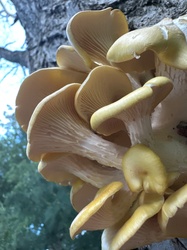
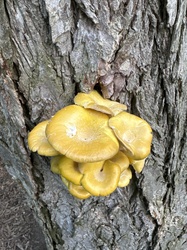
A clustered oyster mushroom with bright lemon to golden-yellow caps that flatten into shallow funnels, with white decurrent gills on fused off-centre stalks.
Overview
The Golden Oyster is an East Asian member of Pleurotus, the oyster mushroom genus, and the most vividly yellow wood-rotting gilled fungus in most regions where it occurs. Clusters emerge from a single fused base and can carry dozens of caps, each starting as a bright golden knob and expanding into a shallow, thin-fleshed funnel.
Native to temperate eastern Russia, northern China, Korea and Japan — where it is long known as tamogitake — it is strongly associated with elm and other hardwoods. Widespread cultivation has carried it far beyond that range, and it has established naturalised populations in parts of North America and Europe, where it now fruits on wild elm, box elder and other broadleaf logs.
Its distinctiveness comes from the intensity and uniformity of the yellow, the clustered growth from one point, and the classic oyster architecture: eccentric stalks, gills running well down the stem, and a white to faintly lilac spore print. Like the Pink Oyster it fades with age, dulling to pale yellow, cream or tan, but young clusters are unmistakable.
How to identify it
Cap
Caps are 2–8 cm across, sometimes larger, convex at first with an inrolled margin, then expanding to plane and finally shallowly funnel-shaped or vase-like. The surface is dry to slightly greasy in wet weather, smooth or very finely velvety, and bright lemon, chrome or golden yellow, palest at the margin and fading to buff or dingy cream with age. Mature margins are often wavy, lobed and split.
Gills
Gills are white to cream — notably paler than the cap — crowded, narrow, and clearly decurrent, extending down the stalk and forming low interconnecting ridges near the base. They do not discolour strongly on handling and are not covered by any veil.
Stipe
The stalk is off-centre to lateral, 2–5 cm long and 3–8 mm thick, white to pale yellowish, dry, often curved, and fused with its neighbours into a common tough base attached to the wood. There is no ring and no volva; the base is simply a knot of joined stems.
Flesh and spore print
Flesh is thin, white to pale yellow, soft and pliant, without colour change when cut or bruised. The spore print is white to very pale lilac-grey; on white paper it reads simply white, so a dark surface helps.
Where and when it grows
Pleurotus citrinopileatus fruits on dead and dying hardwood — standing dead trunks, fallen logs, large branches and stumps. Elms (Ulmus) are the classic host across its native range, and in naturalised populations it also takes box elder, maple, cottonwood, willow, ash and other soft broadleaf woods. It does not colonise conifers to any significant degree.
Season runs from early summer into early autumn, peaking in warm, humid weather after rain; it is more heat-tolerant than the pearl oyster, which fruits in cool weather. Its native range covers the Russian Far East, northeastern China, Korea and Japan. Escapes from cultivation have produced established wild populations in the American Midwest and parts of Europe, where it now spreads through riparian woodland along rivers and floodplains.
Ecological role
This is a saprophytic white-rot fungus that decays both lignin and cellulose, leaving colonised wood pale, soft and stringy. It is an aggressive early coloniser of freshly dead hardwood, entering through broken limbs, cut ends and storm wounds, and can dominate a log rapidly once established. Fruiting is prolific: a single well-colonised trunk may produce successive flushes through a warm, wet summer.
Where it has naturalised outside its native range, its rapid colonisation and heavy spore production allow it to occupy dead wood ahead of resident decay fungi, and its spread through floodplain forest has been documented as a case of a cultivated fungus establishing in the wild. Like other oysters it can trap and digest nematodes with specialised hyphal structures, an adaptation to the low nitrogen content of wood. Spores released from the decurrent gills are dispersed by wind and by insects attracted to the clusters.
Similar species
Pleurotus ostreatus, the pearl oyster, shares the shelving habit, decurrent gills and lilac-tinged white print but is grey, brown, tan or blue-grey rather than yellow, and it fruits mainly in cool weather. Faded Golden Oysters can approach cream, but they usually keep a yellow flush at the cap centre and grow from a strongly fused clustered base.
Phyllotopsis nidulans, the orange mock oyster, is orange rather than lemon yellow, has a densely hairy or woolly cap surface, orange gills, and effectively no stalk at all. Gymnopilus species such as Gymnopilus junonius are yellow-orange and grow in clusters on wood, but they have a central stalk, a ring or ring zone, gills that are adnate to slightly decurrent, and a rusty orange-brown spore print — not white. Laetiporus brackets are yellow-orange but have a pore surface instead of gills. Small yellow Pluteus or Bolbitius species on wood have free gills and pink or rusty prints respectively, and stand on a central stem.
Common questions about Golden Oyster
How do I distinguish it from other oyster mushrooms?
Which trees does it fruit on?
What is its spore print colour?
Why is it found outside East Asia?
Golden Oyster found by the community
Photos submitted through the app and matched to this entry.