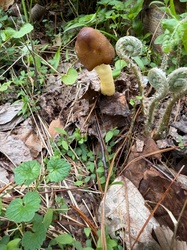
Half-free Morel
Morchella punctipes
Also called semi-free morel, peck's morel, morchella semilibera
A small, dark-ridged morel whose conical pitted cap is joined to the stalk only around its middle, leaving the lower half hanging free like a skirt. The tall, granular white stalk is usually far longer than the cap.
Overview
The Half-free Morel belongs to Morchella, the genus of true morels in the family Morchellaceae, order Pezizales. Like all morels it is an ascomycete: its spores are produced in microscopic sac-shaped cells (asci) that line the inside of the pits, rather than on gills or in tubes as in the more familiar cap-and-stem fungi.
What makes this species instantly recognisable is its cap attachment. In most morels the cap is fused to the stalk right down to its lower rim, so the two form one continuous hollow chamber with no overhang. In the half-free morel the fusion stops roughly halfway up, and the lower part of the cap flares outward and downward as a free skirt that can be lifted with a fingertip. The cap is also disproportionately small for the fungus, often occupying only a quarter to a third of the total height.
In eastern North America the half-free morel is generally treated as Morchella punctipes, while the very similar European fungus long known under this common name is Morchella semilibera. Molecular work has shown that these half-free forms are not one worldwide species but a small cluster of closely related lineages within the black-morel (Elata) clade, each with its own continental range.
How to identify it
Cap
The cap is conical to bluntly bullet-shaped, typically 2-4 cm tall and rather narrow, and is divided into pits by a network of ridges. The primary ridges run more or less vertically, with shorter cross-ridges between them. Pit surfaces are pale tan to olive-brown; the ridges start olive-brown and darken to blackish-brown with maturity. Only the upper portion of the cap is attached to the stalk. Below the line of attachment the cap hangs free, forming a distinct overhanging skirt with a slightly wavy or ragged edge.
Stipe
The stalk is white to pale cream, cylindrical or slightly widening downward, and often 6-15 cm long, so it visibly dwarfs the cap. Its surface is dry and covered in fine mealy granules that can rub off. Cutting the fruiting body lengthwise reveals a single continuous hollow chamber running from the tip of the cap to the base of the stalk, with no cottony filling.
Flesh & spore deposit
The flesh is thin, brittle and pale, and does not change colour appreciably when cut or handled. Older specimens grow flabby and the stalk may develop rusty-brown blotches near the base. A spore deposit is cream to pale yellow. Under the microscope the spores are smooth, elliptical, and produced eight to an ascus, which separates Morchella from the two-spored Verpa bohemica.
Where and when it grows
Half-free morels favour rich, moist, well-drained soils in deciduous woodland, particularly on river terraces, floodplain benches and old alluvial flats. Frequent tree associates in eastern North America include tulip poplar, ash, elm, sycamore, cottonwood and hickory. The species often appears on leaf litter over loamy soil rather than on obvious wood, and can fruit in loose scattered troops of dozens.
It is one of the earliest morels of the year, typically emerging in early to mid spring when soil temperatures first climb and before or alongside the black morels. Fruiting is brief, often lasting only a week or two at a given site. The half-free morels as a group are distributed across the temperate northern hemisphere, with M. punctipes centred on eastern and midwestern North America and its counterparts occupying Europe and parts of Asia.
Ecological role
Morels have an unusually flexible ecology. Some species form loose mycorrhizal associations with tree roots, exchanging soil nutrients and water for plant sugars, while others behave as saprotrophs that break down leaf litter, buried wood and other organic debris. The half-free morel appears to lean toward the litter-decomposing end of that spectrum, recycling nutrients in floodplain soils where seasonal flooding constantly renews the organic layer.
The underground mycelium can condense into sclerotia, hard nutrient-storage bodies that survive drought and cold and later fuel a flush of fruiting bodies. Spores are shot from the asci lining the pit surfaces, sometimes in visible puffs when a mature specimen is jostled, and are dispersed on air currents. Disturbance events such as flooding, soil scraping or the death of a host tree often precede notable fruitings.
Similar species
The closest confusions are with the thimble fungi. Verpa bohemica has a cap attached only at the very apex of the stalk, so the whole skirt hangs free rather than half of it, its cap surface is longitudinally wrinkled and ribbed rather than truly pitted, and its stalk is stuffed with loose cottony pith instead of being cleanly hollow. Verpa conica is likewise apex-attached but has a nearly smooth, bell-shaped cap with almost no folds.
Among true morels, the black morels such as Morchella angusticeps and Morchella importuna have caps fused to the stalk right down to the rim, with no free skirt, and their caps are usually as tall as or taller than the stalk. Morchella importuna further shows a ladder-like arrangement of rectangular pits in neat vertical rows. Yellow morels of the Morchella esculenta group are broader, rounder, paler ochre, and also fully attached.
Common questions about Half-free Morel
How can I tell a half-free morel from a fully attached morel?
Why is the stalk so much longer than the cap?
What trees should I look near?
Is the interior hollow?
Half-free Morel found by the community
Photos submitted through the app and matched to this entry.