Community find
Half-free Morel
Morchella punctipes (alternatively Morchella semilibera complex)
- Group
- Morel
- Spore print
- Cream to yellow-orange
- Size
- Cap 2-4 cm high; stem 5-15 cm long and 1-3 cm thick.
- Season
- Spring (April to May in temperate regions), often coinciding with the emergence of spring wildflowers.
- Habitat
- Found in hardwood forests, often near ash, hickory, or tulip trees, appearing in leaf litter on the forest floor.
- Distribution
- Widely distributed across North America and Europe.
- Key characteristics
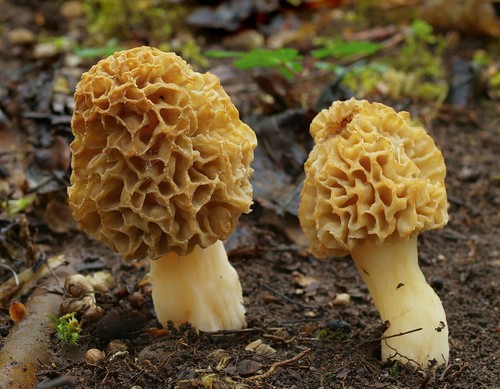
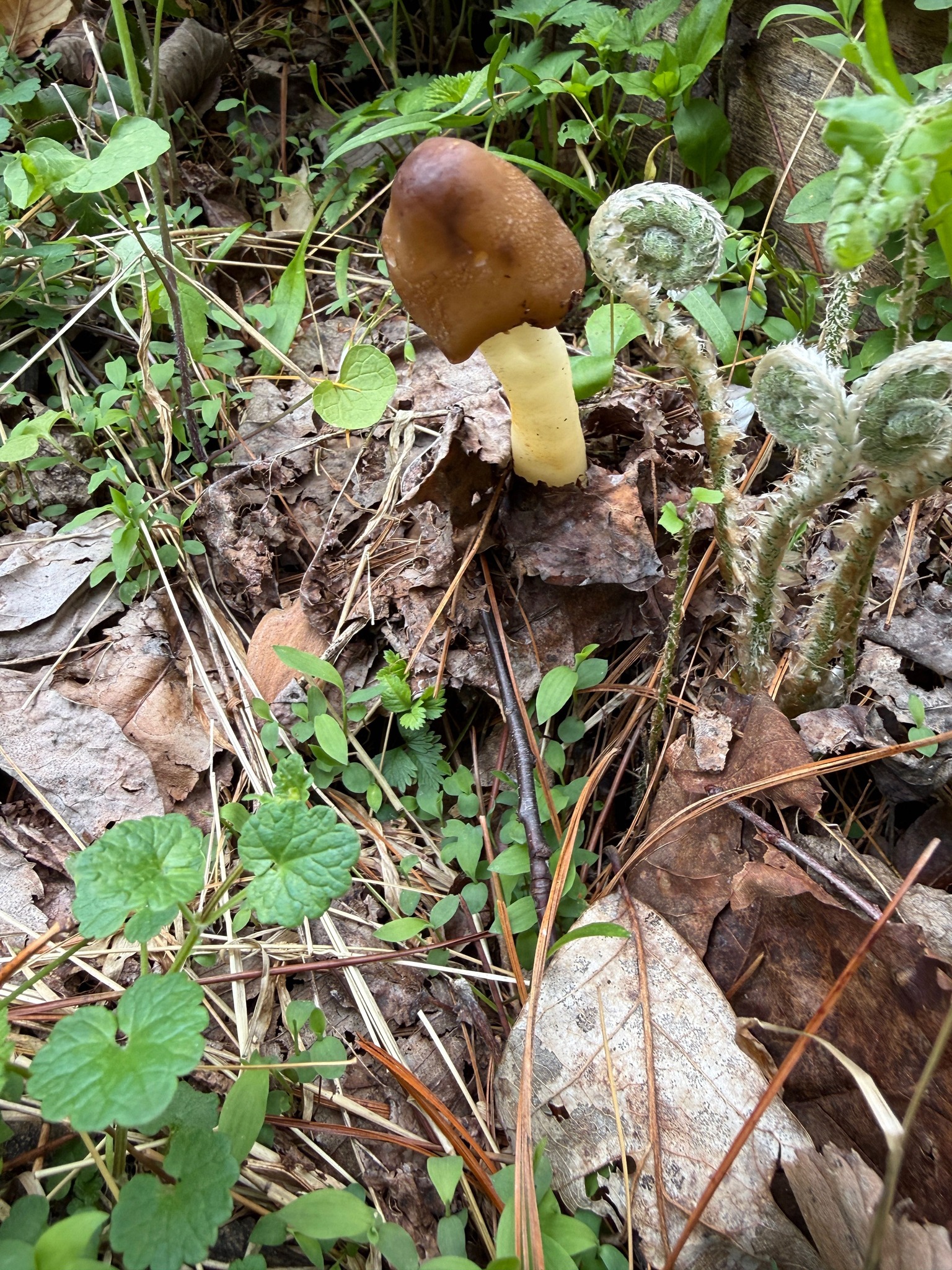
- Conical, pitted cap attached halfway down the stem; long, hollow, fragile stem with a mealy or granular surface.
- Fruiting body
- The cap is brownish to yellowish-brown, honeycombed with ridges and pits; the bottom half of the cap hangs free from the stem. The stipe (stem) is whitish to cream, expanding as it matures, and is hollow.
- How to recognise it
- Slice the mushroom lengthwise; the cap should be attached to the stem approximately halfway down its length, and the entire structure should be hollow.
- Look-alikes
- Verpa bohemica (Early Morel) which has a cap attached only at the very top of the stem, and Morchella americana which has a cap fully attached to the stem.
- Ecological role
- Mycorrhizal or saprophytic; its ecology is complex, likely forming relationships with specific trees while also decomposing organic matter.
- Notes
- Formerly referred to as Morchella semilibera in North America, genetic testing revealed that North American versions are distinct species, such as M. punctipes in the east and M. populiphila in the west.