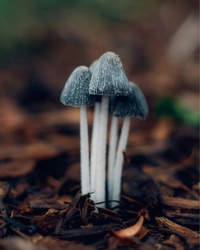
Hare's Foot Inkcap
Coprinopsis lagopus
Also called harefoot mushroom, woolly inkcap
A short-lived inkcap whose young cylindrical cap is wrapped in dense silvery-white wool like a hare's foot, then expands, splits, and curls back within hours. Common on woodchip and litter.
Overview
The Hare's Foot Inkcap, Coprinopsis lagopus, is a study in speed. A fruit body that is a slim, fur-covered cylinder at dawn can be a flat, split, upturned grey disc by mid-morning and a collapsed black smear by evening. Few larger fungi change so completely within a single day.
Its English name and its epithet — lagopus, "hare's foot" — both refer to the young stage, in which the entire cap and much of the stipe are clothed in a dense coat of silvery-white woolly fibres formed from the universal veil. As the cap expands this coat is stretched apart into scattered grey fibrils and finally sheds altogether.
Coprinopsis is the genus into which most of the classic large inkcaps were moved when the old catch-all genus Coprinus was broken up on molecular evidence; only the Shaggy Inkcap and its immediate relatives kept the original name. C. lagopus is one of the most frequently encountered members, thanks to its enthusiasm for the woodchip mulch that now surrounds shrub beds and paths in parks and gardens everywhere. It is also a laboratory workhorse, widely used to study how mushrooms develop and how light and gravity control fruiting.
How to identify it
Cap
At first a narrow cylinder or slim egg 1–3 cm tall, entirely sheathed in dense, soft, silvery-white to greyish woolly fibres. As the cap expands it becomes conical, then bell-shaped, and finally flat with a strongly upturned, split margin, reaching 2–4 cm across. The expanded cap is grey to grey-brown, sometimes paler at the margin, and deeply radially grooved or pleated, with the white wool now reduced to scattered fibrils that soon vanish.
Gills
Free or narrowly attached, crowded and very thin. They are white in the young cylinder, pass rapidly through grey to black, and then auto-digest (deliquesce) from the cap margin inwards, though in this species the collapse is often more a shrivelling and blackening than the dripping ink of the larger inkcaps.
Stipe
Long, slender, and fragile, 6–12 cm tall and only 2–5 mm thick, hollow, white, and covered in fine white woolly or floccose fibrils when young, becoming smoother and more shining with age. It has no ring and the base is slightly swollen but never bulbous or sheathed.
Flesh and spore print
Flesh is extremely thin, whitish, and watery, with no distinctive odour. The whole fruit body is so delicate that it wilts within hours of expanding. The spore print is black.
Where and when it grows
A litter and mulch decomposer, most abundant on woodchip and bark mulch in gardens, parks, shrub borders, and along landscaped paths, where it can appear in large numbers a few weeks after fresh chips are spread. It also grows in leaf litter in deciduous woodland, on compost, in rich garden soil, on straw, and occasionally on well-rotted dung or manured ground.
Fruiting occurs from spring through to late autumn and can be triggered at almost any time by warm, wet conditions; indoors and in greenhouses it may appear year-round. It is cosmopolitan, recorded across Europe, North America, Asia, and beyond. Fruit bodies come up singly or in scattered groups, usually overnight, and are best looked for early in the day.
Ecological role
Coprinopsis lagopus is a saprotroph specialising in freshly available plant debris. It attacks the cellulose and lignin of wood chips, bark, straw, and leaf litter, and is typically an early to middle-stage coloniser: it moves in once bacteria and the fastest moulds have had their turn but before the slower, tougher wood-rotters dominate. On a mulch bed this makes it part of a predictable succession of fungi over the first year or two after the chips are laid.
The rapid life cycle is a direct adaptation to that ephemeral resource. Rather than building a durable fruit body, it invests everything in a fast, tall, thin structure that lifts the spore-bearing surface clear of the mulch, sheds spores from the margin inward as the gills liquefy or shrivel, and is finished before drying weather or competitors can interfere. The stipe is strongly phototropic and gravitropic, bending to hold the cap level and upright even on a sloping surface.
Similar species
Coprinopsis lagopides is very similar in shape and veil but the cap becomes browner, its expanded margin is less strongly upturned, and it favours burnt ground and bonfire sites. Other members of the lagopus complex, such as C. cinerea, differ chiefly in microscopic details and in a preference for dung and composted straw over woodchip.
The Common Inkcap (Coprinopsis atramentaria) is far more robust, with a smooth, pale ochre-grey egg-shaped cap lacking any woolly coat, growing in dense clusters from buried wood. The Pleated Inkcap (Parasola plicatilis) is much smaller and thinner, has a completely bald, deeply grooved tan-centred cap with no woolly veil at any stage, and grows in lawns rather than mulch.
Common questions about Hare's Foot Inkcap
Why is it called Hare's Foot?
How long does a fruit body last?
Where is it most likely to appear?
What is its role in the ecosystem?
Hare's Foot Inkcap found by the community
Photos submitted through the app and matched to this entry.