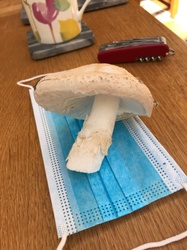
Horse Mushroom
Agaricus arvensis
Also called snowball mushroom
A large, robust white grassland Agaricus with a distinctive double 'cogwheel' ring, greyish-white young gills that turn chocolate-brown, and a strong aniseed odour. It forms troops and rings in open pasture.
Overview
Agaricus arvensis is one of the largest of the grassland Agaricus species, regularly reaching 10-20 cm across and standing well clear of the sward. Like the rest of the genus it has free gills, a dark chocolate-brown spore print and a ringed stem with no volva, but its size, ring structure and odour set it apart from its relatives.
The ring is the classic feature. It is thick, double-layered and pendulous, and its underside splits radially into blocky segments arranged like the teeth of a cogwheel - a structure worth examining carefully because it is diagnostic within the group. Young buttons are almost perfectly rounded and gleaming white, which explains the alternative name Snowball Mushroom.
A. arvensis also has a marked sweet, aniseed or marzipan-like odour, most obvious in fresh young fruitbodies. Along with the gradual creamy-yellow ageing of the cap surface, this places it in the informal group of yellowing, anise-scented Agaricus species that also includes the Wood Mushroom.
How to identify it
Cap
8-20 cm across and occasionally larger, hemispherical to almost spherical in the button stage, then convex and finally broadly flat. It is white and smooth, sometimes silky, ageing to creamy or ochre-yellowish overall, particularly where handled or rubbed; the yellowing is gradual and dull rather than instant and vivid.
Gills
Free and crowded, and importantly pale greyish-white to pale pinkish-grey when young - never the bright salmon-pink of the Meadow Mushroom. They darken through greyish-pink and purple-brown to a deep chocolate-brown at maturity.
Stipe
6-15 cm long and stout, white, smooth above the ring and sometimes slightly scurfy below, with a base that is often somewhat swollen but has no sac or cup. The ring is large, thick, double and pendulous; its lower surface breaks into radiating blocks giving the characteristic cogwheel or star pattern.
Flesh & spore print
Flesh is thick, firm and white, becoming slowly and faintly yellowish where cut in the cap and upper stem, but without any intense chrome-yellow flush at the stem base. The odour is distinctly sweet and aniseed-like. The spore print is dark chocolate-brown.
Where and when it grows
It grows on soil in open, nutrient-rich grassland: permanent pasture, meadows, paddocks, roadside verges, downland, dunes and grassy areas near stables and farmyards. It is strongly associated with grazed and manured ground and also appears at woodland edges and in grassy clearings, but not on wood or deep leaf litter.
The season is long, running from early summer through to late autumn, with the biggest flushes after warm rain. Fruitbodies commonly form troops, arcs and complete rings. Agaricus arvensis is widespread and common across Europe, North America and temperate Asia, though like other pasture specialists it has declined where old grassland has been ploughed or intensively improved.
Ecological role
The Horse Mushroom is saprophytic, decomposing dead grass roots, thatch and manure-enriched organic matter in the upper soil. It is not associated with tree roots, and its nitrogen preference explains its strong link with grazed and manured land, especially horse pasture.
Its perennial mycelium spreads radially through the turf, producing the arcs and rings typical of grassland fungi and returning nitrogen and phosphorus from decomposed root material to the sward. The large fruitbodies are an important seasonal resource for fly larvae, beetles, slugs and small mammals, and the species is used as an indicator of long-established, unimproved grassland.
Similar species
The Meadow Mushroom (Agaricus campestris) is smaller and shorter-stemmed, with bright salmon-pink young gills, a thin simple fragile ring and no aniseed odour, and it does not yellow. The Yellow Stainer (A. xanthodermus) is the most important morphological confusion: it also has a large white cap and a big ring, but its young cap is often squared-off in outline, it stains bright chrome-yellow the moment the cap margin is rubbed, the cut stem base flushes vivid yellow, and the odour is ink- or phenol-like rather than sweet.
The Wood Mushroom (A. silvicola) is a slimmer woodland species with the same aniseed odour and yellowing but a distinctly bulbous stem base. White Amanita species such as the Destroying Angel (A. virosa) are separated structurally by gills that remain pure white, a white spore print, and a membranous sac (volva) enclosing the stem base, which must be dug up rather than snapped to be seen.
Common questions about Horse Mushroom
What is the cogwheel ring?
How do I separate it from the Meadow Mushroom?
What should it smell like?
Does the flesh change colour when cut?
Horse Mushroom found by the community
Photos submitted through the app and matched to this entry.