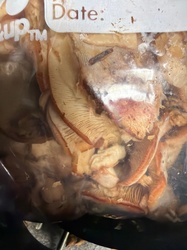
Lobster Mushroom
Hypomyces lactifluorum
Also called lobster fungus, lobster russula
Not a mushroom in its own right but a parasitic ascomycete that encases Russula and Lactarius fruitbodies in a pimpled, brilliant orange-red crust, twisting them into dense, contorted shapes.
Overview
The Lobster Mushroom is one of the strangest objects a walker can pick up in North American woodland: a hard, bright orange-red, vaguely mushroom-shaped lump that looks fired in a kiln. What is actually being seen is two organisms at once. The visible orange layer is Hypomyces lactifluorum, a mycoparasitic ascomycete in the family Hypocreaceae, while the pale bulk underneath is the deformed body of a host mushroom, almost always a large white Russula or Lactarius.
Because the parasite takes over early in the host's development, the host never expresses its own form properly. Gills are suppressed to blunt ridges or erased entirely, the cap becomes lopsided and inrolled, and the whole fruitbody hardens. The name refers to the shell-like colour and the way the crust cracks, not to any relationship with crustaceans.
Hypomyces is a large genus whose members specialise on particular hosts — some on boletes, some on Amanita, some on other ascomycetes. H. lactifluorum is the most conspicuous of them because of its saturated colour and the size of the hosts it takes over.
How to identify it
Surface
The entire fruiting mass is sheathed in a thin, hard, matt to slightly shiny layer coloured deep orange, orange-red or nearly scarlet, fading to dull orange or purplish with age. Under a hand lens the crust is finely roughened by countless pinhead bumps: these are the embedded flask-shaped perithecia in which spores are produced.
Gills
Any hymenium the host would have formed is drastically altered. In young colonised fruitbodies the gills are reduced to low, blunt, waxy-looking ridges that are also orange; in older ones the underside is simply smooth or shallowly wrinkled. The absence of true, sharp-edged gills is one of the quickest confirmations that a parasite is involved.
Stipe
The stipe of the host remains as a short, thick, often eccentric column, likewise coated in orange crust, sometimes with a whitish uncolonised base where the parasite has not reached.
Flesh & spores
Internal flesh is white to very pale cream, dense, firm and brittle, and does not change colour when cut. No spore print can be taken, because the reproductive tissue belongs to the parasite: spores are produced in asci inside the perithecia and are spindle-shaped, warted and two-celled with a small point at each end.
Where and when it grows
Lobster Mushrooms appear wherever their hosts do — under conifers such as spruce, fir and hemlock, and in mixed woodland with oak, beech and birch. They are terrestrial, arising from soil and duff, often partly buried so that only a dome of orange breaks the leaf litter; scratching around the lump usually reveals the rest of the deformed host.
The species is common across North America from the Pacific Northwest to the Appalachians and eastern Canada, and reports elsewhere are far more scattered. Fruiting runs through summer and autumn, following the same warm, wet spells that bring up large white Russula fruitbodies, with which its life cycle is tied.
Ecological role
Hypomyces lactifluorum is a mycoparasite: it derives its nutrition from another fungus rather than from wood, litter or a plant partner. Spores land on a developing Russula or Lactarius button, germinate, and the parasitic mycelium spreads through the host tissue, eventually covering the exterior and producing its own perithecia in the crust.
The host itself is ectomycorrhizal, so the parasite is indirectly plugged into the tree-root economy of the forest — a third link in a chain running from tree to Russula to Hypomyces. Recorded hosts include Russula brevipes, related short-stemmed white russulas, and stout white Lactarius species such as L. piperatus; the pairing explains why the fungus appears in the same spots year after year.
Similar species
Other Hypomyces species are the closest comparison. Hypomyces chrysospermus grows on boletes and forms a soft white mould that turns powdery golden yellow, quite unlike the hard orange shell here, and its host retains recognisable pores. Hypomyces luteovirens also attacks russulas but produces a granular yellow-green coating restricted mainly to the gills, leaving the cap surface visible.
An uncolonised Russula brevipes is the obvious point of contrast: it is chalky white to dingy buff, has proper close white gills, brittle granular flesh and a white spore print, and lacks any crust. Old, sun-baked Lactarius fruitbodies can develop orange-tan patches, but the colour is in the flesh rather than in a separate pimpled skin, and the gills stay sharp-edged.
Common questions about Lobster Mushroom
Why does a Lobster Mushroom have almost no gills?
Can a spore print be taken from one?
Which mushrooms does it grow on?
Is the orange colour present when it first emerges?
Lobster Mushroom found by the community
Photos submitted through the app and matched to this entry.