
Oakbug Milkcap
Lactarius quietus
Also called oak milkcap, bug milkcap
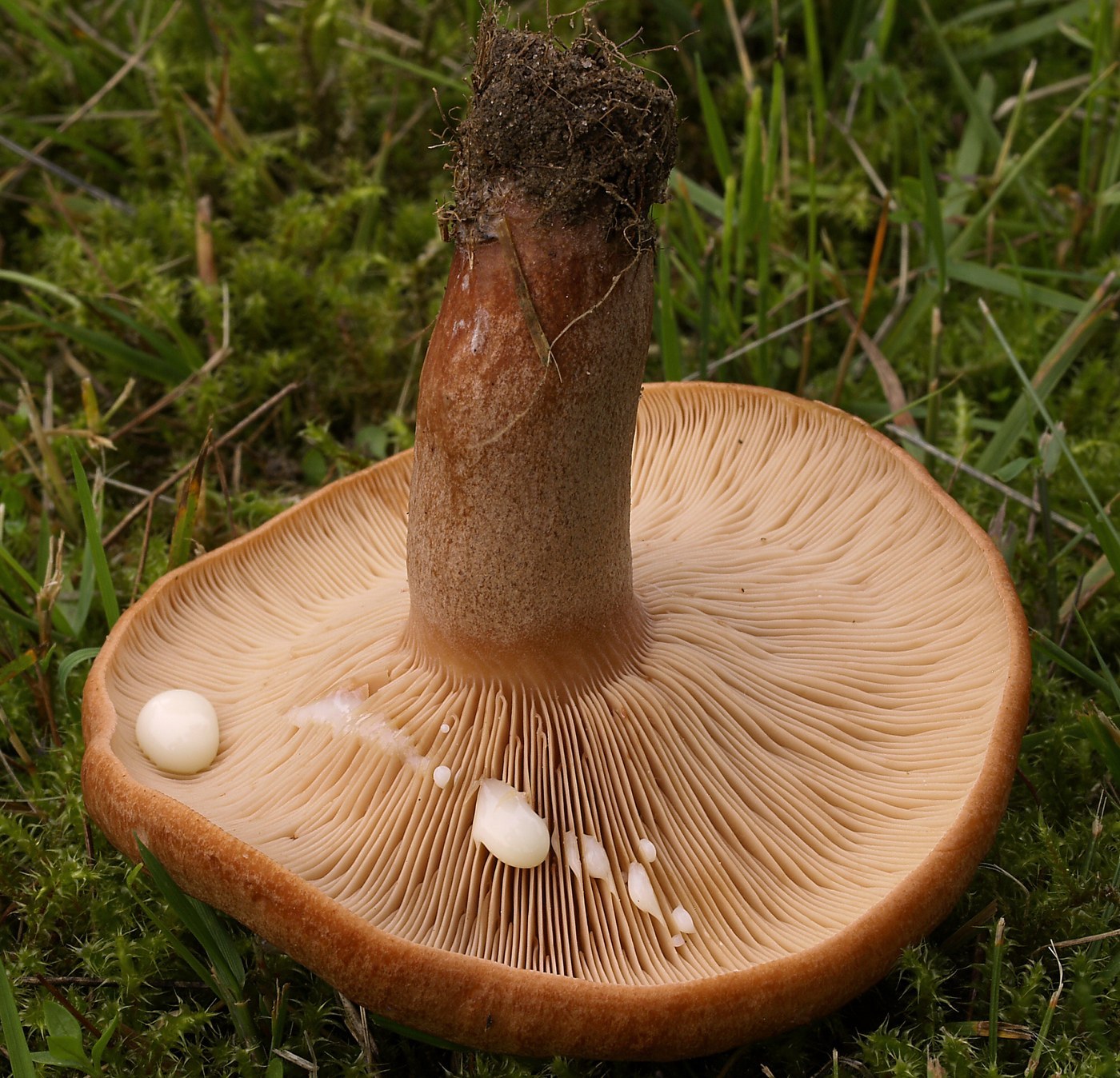
An abundant oak-associated milkcap with a dull cinnamon-brown, faintly banded cap and a heavy oily odour. Its creamy white latex does not change colour but dries brownish on the gills.
- Group
- Gilled
- Cap
- Dull reddish-brown cap with faint concentric zones
- Spore print
- Pale cream with pinkish tint
- Habitat
- Under oak, on soil and leaf litter
- Season
- Late summer to late autumn
Overview
The Oakbug Milkcap is one of the most abundant woodland fungi wherever oaks grow, forming long scattered troops through the leaf litter from late summer into November. Its dull, slightly greasy reddish-brown cap with vague darker banding is easy to pass over, but its sheer numbers make it a species every woodland observer meets repeatedly.
Within Lactarius it belongs to the group of medium-sized brown milkcaps with unchanging white latex and pale spore deposits. Its two most useful characters beyond the cap colour are its exclusive partnership with oak and its distinctive oily, slightly rancid odour — the "bug" of the common name refers to the smell being likened to bedbugs.
Because its host preference is so narrow, the species doubles as an ecological indicator: a troop of them is a reliable sign that oak roots run beneath, even where the canopy above is mixed.
How to identify it
Cap
4–8 cm across, convex with an inrolled margin when young, expanding to flat and finally shallowly depressed. The surface is smooth, matt when dry and slightly greasy when damp, dull reddish brown, cinnamon or milky-coffee coloured, and typically marked with faint darker concentric zones or diffuse blotchy bands. The margin is even and only faintly grooved in old fruitbodies.
Gills
Crowded, adnate to slightly decurrent, pale pinkish buff at first and darkening to dull ochre-buff, developing rusty brown spots where damaged or with age.
Stipe
4–8 cm tall and 1–2 cm thick, cylindrical or slightly swollen in the middle, coloured like the cap or darker toward the base, often with darker longitudinal streaks or a subtly banded look. It is firm at first, later stuffed and hollow.
Flesh and latex
The flesh is whitish to pale buff, brittle, sometimes tinged reddish under the cap surface. The latex is creamy white, moderately abundant and unchanging in colour, drying brownish and spotting the gills. The odour is strong and characteristic — oily, faintly rancid, often compared to bedbugs. Spore deposit pale cream, frequently with a pinkish tinge.
Where and when it grows
This species is essentially restricted to oak. It grows on soil among leaf litter under both native and planted oaks, in woodland, parkland, hedgerows, avenues and even isolated street trees, and it can fruit in remarkable abundance beneath a single mature tree.
The season is long, running from late summer through to the first frosts of late autumn, with a strong peak in October. It is common and widespread throughout Europe wherever oaks occur, and follows planted oaks into regions where they are not native.
Ecological role
The Oakbug Milkcap is ectomycorrhizal and highly host-specific, forming sheathing mycorrhizas almost exclusively on the fine roots of Quercus. This specialisation means its distribution maps closely onto that of oak, and it is one of the standard associates of both ancient oak woodland and young planted trees.
As one of the most abundant mycorrhizal fungi in oak systems, it plays a substantial role in the tree's nutrient economy, extracting nitrogen and phosphorus from the litter layer and shuttling it to the roots. Its dense annual fruiting also delivers a large pulse of biomass to litter invertebrates and small mammals, and the persistent mycelial network links neighbouring oak roots underground.
Similar species
The Yellowdrop Milkcap (Lactarius chrysorrheus) also grows with oak and can look similar, but it is paler pinkish buff and its latex turns bright yellow within seconds — the Oakbug Milkcap's latex stays white. The Beech Milkcap (Lactarius blennius) is olive-grey and viscid with dark watery spots, and grows under beech.
Lactarius subdulcis is smaller, brighter cinnamon, unzoned and found under beech, while Lactarius serifluus is darker with a watery latex and a different odour. The tree partner alone separates most of these in practice.