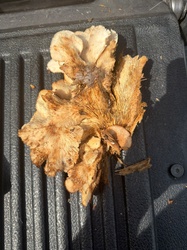
Oyster Mushroom
Pleurotus ostreatus
Also called pearl oyster, tree oyster, hiratake
A shelving, shell-shaped mushroom with white decurrent gills running down a short off-centre stem, growing in overlapping tiers on hardwood trunks. Colour varies from slate-grey and brown to almost white.
Overview
Pleurotus ostreatus is the type species of a genus of wood-decaying agarics that grow as laterally attached brackets rather than on a central stem. The fan or oyster-shell outline, the gills running right down onto the point of attachment, and the shelving, tiered growth habit make the genus one of the more distinctive groups of gilled fungi.
Colour is variable and depends heavily on temperature and light: cold-weather fruitings tend to be dark slate-grey to blue-grey, while milder conditions produce tan, buff or nearly white caps. This variation, plus a number of closely related species, means the oyster mushrooms are best treated as a group recognised by structure rather than colour.
Ecologically the genus is unusual. As well as decaying wood, Pleurotus mycelium captures and digests nematodes in the substrate, making it one of the few carnivorous larger fungi - an adaptation to the low nitrogen content of dead wood.
How to identify it
Cap
5-20 cm across, shell-, fan- or oyster-shaped with an inrolled margin when young, flattening and becoming wavy or lobed with age. The surface is smooth, dry to slightly greasy in wet weather, and ranges from dark blue-grey and slate through brown and tan to cream. Caps overlap in shelving tiers, sometimes in large stacked clusters on a trunk.
Gills
White to greyish-cream, fairly crowded, and strongly decurrent - running clearly down onto the stem or, where there is no stem, onto the point of attachment. Gills often fork or interconnect near the base, forming a network at the attachment.
Stipe
Either absent or a short, thick, off-centre to lateral stub 1-4 cm long, usually white and often woolly-hairy at the very base where it grips the bark. There is no ring and no volva.
Flesh & spore print
White, thick and firm near the attachment, thinning to the margin, and unchanging when cut. The spore print is white with a distinct lilac or greyish tinge, often visible as a pale bloom on lower caps in a tiered cluster.
Where and when it grows
It grows on dead and dying broadleaf trees - standing trunks, fallen logs, stumps and large wounds on living trees. Beech is the classic host in Europe, with poplar, willow, ash, birch, oak, horse chestnut and elm also frequent; it is rare on conifers. Clusters often appear high on a trunk where a limb has broken off.
Fruiting can occur in any month but is heaviest in autumn and early winter, and cold snaps often trigger a flush. Pleurotus ostreatus is widespread throughout Europe, North America and temperate Asia, and closely related species occupy warmer regions and different host trees within the same range.
Ecological role
The Oyster Mushroom is a white-rot fungus and a weak parasite. It degrades lignin efficiently, leaving pale, fibrous, softened wood, and can colonise living but stressed trees through wounds before continuing as a saprophyte once the tree dies. Large trunks may be recycled over several years by successive flushes from the same mycelium.
Its nematode-trapping behaviour is a notable adaptation: specialised hyphal structures immobilise soil and wood nematodes, and the fungus then digests them for nitrogen, which is otherwise scarce in dead wood, offsetting a shortfall that wood alone cannot cover. Colonised trunks become important microhabitats, supporting fungus gnats, rove beetles and other saproxylic invertebrates, and hollowed white-rotted trunks eventually provide nest cavities for birds and bats.
Similar species
The Pale Oyster (Pleurotus pulmonarius) is thinner-fleshed, paler cream to white, with a longer and more distinct stem, and fruits mainly in summer. The Branched Oyster (P. cornucopiae) has a deeply funnel-shaped cap and gills that run down and form a raised network on the stem, with fruitbodies fused at a common branched base.
Oysterlings (Crepidotus species) are much smaller, thinner, whitish and stemless, and have a brown spore print. The Olive Oysterling (Panellus serotinus) has an olive-green to violet-tinged cap with a short yellowish, scurfy stub and narrow orange-tinted gills. Angel's Wings (Pleurocybella porrigens) is pure white, very thin and pliant, and grows on conifer wood, while Lentinellus species have jagged, saw-toothed gill edges.
Common questions about Oyster Mushroom
Why do oyster mushrooms vary so much in colour?
What does 'decurrent gills' mean here?
How do I distinguish it from small oysterlings?
Is it true this fungus traps nematodes?
Oyster Mushroom found by the community
Photos submitted through the app and matched to this entry.