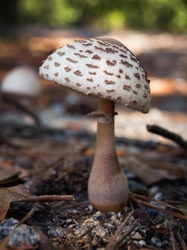
Parasol Mushroom
Macrolepiota procera
Also called common parasol, snakeskin parasol
One of the largest European grassland agarics, recognised by its drumstick-shaped young form, shaggy brown cap scales and a snakeskin-patterned stem carrying a thick, movable double ring.
Overview
The Parasol Mushroom is the archetype of the genus Macrolepiota, a group of large, pale-capped, white-spored agarics in the family Agaricaceae. It is among the tallest mushrooms found in temperate grassland, with mature fruit bodies frequently standing 25-40 cm high and spreading a cap that can exceed 30 cm across. The overall silhouette gives the species its name: a broad, shallowly domed disc held on a slender, rigid stem, exactly like an opened parasol.
What sets M. procera apart from its many relatives is the combination of three features that can all be checked in the field at once: the coarse, dark brown, shingle-like scales scattered over a pale buff cap surface; the finely banded, dark-on-pale stem patterning often described as snakeskin or python-skin; and a thick, double-layered ring that can be slid up and down the stem with a fingertip. Very few other agarics carry all three.
Within the fungal world this species sits among the litter-decomposing Agaricaceae rather than the tree-partnered mushrooms. It is closely allied to the genera Chlorophyllum and Leucoagaricus, which share the pale free gills and scaly caps, and the modern boundaries between these genera have been redrawn several times as molecular work has clarified relationships. The Parasol has retained its position as the type species around which the rest of the group is compared.
How to identify it
Cap
Starts as a tight, ovoid to egg-shaped knob on a long stem, giving the classic drumstick appearance. It then expands to broadly convex and finally almost flat, 10-30 cm across, occasionally more. The ground colour is pale greyish buff to cream; the original dark brown cuticle breaks up as the cap expands into concentric, coarse, upturned scales, leaving a solid, unbroken dark brown patch (the umbo) at the very centre. The margin is often shaggy and slightly overhanging.
Gills
Free from the stem, leaving a distinct gutter or collar between the gill ends and the stem apex. They are crowded, soft, broad, and white to cream, sometimes darkening to a dull buff with age. The gill edges may be minutely fringed.
Stipe
Very long relative to the cap, 15-40 cm tall but only 1-2 cm thick, tapering upward from a distinctly bulbous base. The surface below the ring is covered in fine transverse brown banding on a pale ground, the snakeskin or zebra pattern that is the single most reliable field mark. The ring is thick, double-edged, and detaches from the stem so it can be slid freely.
Flesh and spore print
The flesh is soft, white, and does not change colour appreciably when cut, or at most turns very faintly pinkish in the stem base. The spore deposit is white to very pale cream. Spores are large, thick-walled and ellipsoid with a germ pore.
Where and when it grows
Macrolepiota procera is a species of open, well-drained, unimproved ground: old pasture, hay meadows, roadside verges, parkland, dune grassland, and the grassy margins, rides and clearings within deciduous woodland. It also appears along hedgerows and in open conifer plantations on light soils. It is not attached to any particular tree, and fruit bodies commonly stand in the middle of turf far from any woody plant.
Fruiting runs from midsummer through to the first hard frosts of autumn, peaking after warm, wet spells in late summer. The species is widespread across Europe and temperate Asia, extends into North Africa, and is recorded in parts of North America, though many North American records refer to related Macrolepiota and Chlorophyllum taxa. Fruit bodies often arise scattered, in loose troops, or in arcs and rings that mark the outward growth of the underlying mycelium.
Ecological role
This is a saprotrophic fungus. Its mycelium spreads through the upper soil layers and the thatch of decaying grass and leaf litter, breaking down cellulose and lignin-rich plant debris and releasing mineral nutrients back into the turf. Because it does not depend on a living host, it can colonise disturbed and man-made grasslands and can persist in one meadow for many decades.
The expanding mycelial front produces the ring and arc fruiting patterns seen in old pasture. The tall stem lifts the cap clear of the surrounding sward, and the wide, exposed gill surface releases spores into the moving air above the grass canopy, an arrangement well suited to open habitats where there is no woodland structure to catch and disperse spores.
Similar species
The Shaggy Parasol, Chlorophyllum rhacodes, is the closest confusion. It has a smooth, plain stem with no snakeskin banding, a more coarsely and evenly shaggy cap without a solid contrasting central disc, and flesh that turns saffron then reddish brown when cut. Chlorophyllum molybdites is separated instantly by its green to grey-green spore print and gills that dull to green in age. Smaller Lepiota species share the scaly cap and free white gills but rarely exceed 6 cm across and have a thin, fixed ring.
Amanita species such as the Blusher or the Grey Spotted Amanita can superficially resemble a parasol at a distance, but they have a fixed, skirt-like ring that cannot be slid, a stem base sitting in a membranous sac or a distinctly marginate bulb, and cap ornamentation consisting of loose warts or patches rather than the torn, concentric shingles of a true parasol. None of the Amanita look-alikes shows the transverse stem banding.
Common questions about Parasol Mushroom
What is the single most reliable field mark for the Parasol Mushroom?
Why can the ring be moved up and down?
How large can it get?
Does it grow with particular trees?
Parasol Mushroom found by the community
Photos submitted through the app and matched to this entry.