Identification guide
Pleated Inkcap Identification Guide
A morning-walk guide to Parasola plicatilis: the tiny pleated parasol in lawn grass, the collar the gills attach to, the black spore print, and how it differs from its closest relatives.
First impressions and the setting
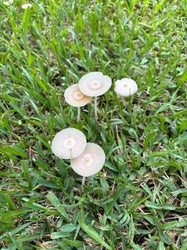
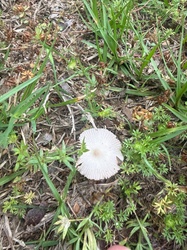
The Pleated Inkcap is an early riser and an early quitter. Walk across a damp lawn, a grassy verge, a park sward or a mossy path edge on a summer or autumn morning after overnight rain, and you will see slender white stalks a few centimetres tall, each carrying a tiny grey parasol 1-3 cm across held perfectly flat. By early afternoon on a warm day, most of them will have collapsed into limp threads.
The first impression is of a Japanese paper umbrella in miniature. The cap is so thin and so deeply grooved that the whole thing looks pleated like a fan, and viewed from above the radial furrows converge on a small darker central disc. It fruits singly or in loose scattered groups over the turf, never in dense fused tufts.
Reading the cap
Watch a population rather than a single specimen, because the developmental sequence is part of the identification.
A button is a small, upright, ochre to tan cylinder or egg, perhaps 5 mm tall, hugging the stem. As it matures the cap expands rapidly outwards, becoming bell-shaped, then convex, then completely flat, and finally reflexed with the margin lifted above the horizontal. A fully expanded cap is often the thickness of tissue paper.
The surface carries deep radial grooves running from the margin right in to a small central disc, each groove corresponding to a gill beneath. Colour is graded: the disc stays ochre, tan or pale brown, sometimes with a slightly reddish tinge, while the pleated area is grey to grey-brown, becoming paler and greyer as the cap flattens and dries. The overall effect is a grey wheel with a small warm-toned hub.
Under a hand lens the surface is essentially smooth to finely velvety in the central area, without conspicuous coarse hairs or granules. That matters for separating the relatives, so use the lens rather than trusting the naked eye.
Gills and the collar
This is a small mushroom with a specific gill architecture, so use a lens.
The gills are few, narrow, widely spaced and radiate from the centre like the ribs of an umbrella. They are pale grey at first and blacken from the margin inwards as spores mature, so a mid-aged cap has a black outer zone and a grey inner zone.
Crucially, they do not attach directly to the stipe. They terminate on a narrow free collar encircling the stem, so a needle can be passed between the collar and the stipe. A cap detached from its stem often carries the whole collar with it as a small dark ring.
Unlike the classic inkcaps, these gills do not dissolve into a dripping black ink. They may darken, shrivel and collapse, but the cap simply withers rather than liquefying. If you find genuine black liquid dripping from the cap margin you are in a different genus.
Stipe, base and flesh
The stipe is 4-9 cm long and only 1-2 mm thick, straight, cylindrical, hollow and fragile, and it is white to very pale grey, sometimes translucent when wet. It is smooth to very finely silky and does not carry a ring, a ring zone or a volva.
The base is slightly swollen at most, without a bulb, sheath or cup, and it inserts into soil, thatch or buried grass debris. Lift the specimen with a knife and check the base for any attachment to woody material, because a wood attachment would send you towards different species.
The flesh is almost non-existent, grey to whitish, watery, and it changes no colour when cut, since there is barely enough of it to see a change. There is no latex, no distinctive odour, and no bruising reaction. The entire fruit body is designed to appear, drop spores and vanish inside a day.
Taking and reading a spore print
Speed is everything here. If you find these mid-morning, print them the same hour. Cut the cap free at the collar with a razor or fine scissors and lay it gill-side down on white paper under a small upturned glass, ideally with a damp scrap of paper for humidity.
One to three hours is usually plenty; this species drops fast and copiously for its size. The print is black to blackish-brown, and on white paper it shows as a starburst of well-separated dark rays because the gills are so widely spaced.
That black print does most of the diagnostic work. Any tiny pleated parasol with a white spore print is not a Parasola.
Substrate, season and ecology
Parasola plicatilis is a saprotroph of grassy, nitrogen-rich, disturbed soil. Its usual haunts are lawns, mown verges, park grass, garden borders, path edges and mossy turf, where it decomposes grass thatch, dead roots and other buried herbaceous debris. It is not a wood-rotter and not tied to living plants.
Fruiting runs from late spring to autumn in temperate regions and is triggered directly by rain. It typically emerges overnight, expands at dawn, releases spores through the morning and collapses by afternoon, which is why the species is under-recorded despite being extremely common. The best strategy is simply to walk the same lawn early on the morning after heavy rain.
Separating it from look-alikes on morphology alone
Parasola leiocephala. Extremely close. Its cap disc tends to be a warmer date-brown to reddish-brown and the overall cap slightly larger, and it is more a species of woodland edges, paths and leaf litter than of open mown turf. The reliable separations are microscopic, so in the field it is legitimate to note the disc colour and habitat and record the pair as an aggregate.
Parasola auricoma. Look at the cap under a hand lens or in strong side-light. Auricoma carries scattered thick, dark, stiff hairs on the cap surface, visible as fine bristles, and its disc is often a stronger red-brown. It also favours wood chip mulch and disturbed bare ground. Plicatilis lacks those coarse hairs.
Parasola conopilea and taller relatives. Considerably taller and with a more conical, less flattened cap that never opens into a horizontal disc in the same way.
Fairy Inkcap (Coprinellus disseminatus). Superficially similar tiny pleated caps, but it grows in enormous dense troops of dozens or hundreds directly on and around rotting stumps and buried wood, its caps are more bell-shaped and buff-ochre, and its surface is finely hairy under a lens. It never forms the flat plate with a free collar in scattered lawn turf.
Coprinopsis and Coprinellus inkcaps proper. These genuinely deliquesce, dripping black liquid from the cap margin, and most are larger with veil remnants as scales or granules on the cap.
Pinwheel Mushroom (Marasmius rotula). Also pleated with a collar, but its cap is white with a dark navel, its stem is wiry, shiny and black-brown, it grows on twigs and woody debris, it revives after drying, and its spore print is white rather than black.
Panaeolus species. Share dark spores and grassland habitat, but their caps are convex and smooth rather than flat and deeply pleated, their gills are mottled rather than evenly blackening, and their flesh is far more substantial.
A quick field sequence
Morning, damp turf. Tiny grey pleated parasol, flat, 1-3 cm, with a tan central disc. Cap smooth under a lens, no bristles. Gills few, distant, blackening, attached to a free collar, not dissolving into ink. Stipe white, thread-like, hollow, no ring, no volva. Black spore print within a couple of hours. That is the Pleated Inkcap.
Common questions
Does the Pleated Inkcap really turn to ink?
How do I separate it from Parasola auricoma?
Where and when should I look for it?
What is it feeding on in a lawn?
Full reference entry for Pleated Inkcap
Cap and fruiting body, spore print colour, substrate, season, ecological role and the species most often confused with it.
Open the Pleated Inkcap entry →