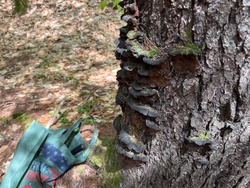
Red-belted Conk
Fomitopsis pinicola
Also called red-belted polypore, red banded polypore
A tough perennial bracket recognised by a shiny resinous crust banded in red-orange with a cream to white growing edge, and a hard white context. It is among the most abundant decay fungi of conifer logs in northern forests.
Overview
Fomitopsis pinicola is one of the anchor species of the Fomitopsidaceae, a family of brown-rot polypores with white to pale context and white spores. It is exceptionally common — in many boreal and montane forests it is the single most frequently encountered bracket fungus, colonising fallen conifer trunks in numbers.
The name comes from the banding on the upper surface. Young, actively growing margins are white to cream; behind them lies a zone of bright red-orange to blood-red resinous crust; and behind that, older tissue darkens to grey, black or dull brown. A mature bracket therefore reads as a series of concentric belts recording its own growth history. The crust is genuinely resinous and softens or blisters when heat is applied, a classic field check.
Recent work has split what was long treated as a single circumboreal species into several regional taxa — including forms restricted to North America and to Europe — but the field appearance, ecology and identification characters described here apply across the complex.
How to identify it
Cap
The fruiting body ranges from a flattened shelf to a thick hoof or knob, 5–40 cm wide and up to 20 cm thick. The upper surface is hard, smooth and coated in resin, giving it a slightly glossy or lacquered sheen. Colour is strongly zoned: a whitish to cream margin, then a red-orange to reddish-brown belt, then progressively darker grey-brown to nearly black older zones. On logs the bracket often develops as an irregular knob or a resupinate crust with a rolled edge.
Pores
The pore surface is white to cream, sometimes ageing pale yellow, and bruises faintly brownish or yellowish. Pores are round and fine, about 3–5 per millimetre. The tube layers are stacked annually and are pale, contrasting little with the context.
Stipe
Absent. The bracket is sessile, attached broadly to the wood, and frequently reorients if the log rolls — producing distorted specimens with pore surfaces facing in two directions.
Flesh & spore print
The context is white to pale buff or cream, tough, corky to woody, and does not change colour appreciably when cut. The spore deposit is white. The combination of white context, white spores, a resinous banded crust and a conifer substrate is diagnostic.
Where and when it grows
Red-belted Conk grows on dead conifers above all — spruce, fir, pine, hemlock, larch and Douglas-fir — appearing on fallen trunks, standing snags, stumps and large branches. It also occurs on hardwoods, particularly birch, alder and maple, though less often. It readily colonises recently killed wood and can persist on the same log for many years.
It is circumboreal and montane, common throughout northern and central Europe, Siberia, and across Canada and the northern and mountainous United States, extending south at elevation. Because it is perennial and highly weather-resistant, brackets are present in every season; new white margins form during the spring and summer growth period.
Ecological role
This is a brown-rot fungus. It removes cellulose and hemicellulose while leaving lignin largely intact, so decayed wood turns reddish brown, shrinks, and breaks into cubical blocks that crumble to powder between the fingers. That residue is highly stable and contributes disproportionately to long-term forest soil carbon.
It is primarily a saprotroph of dead wood but can act as a wound parasite on stressed living trees. The cubically rotted logs it produces are important nurse sites for conifer seedlings, hold moisture through dry seasons, and provide burrow habitat for salamanders, small mammals and invertebrates. In managed forests it is a principal agent recycling logging slash and windthrow.
Similar species
Fomes fomentarius shares the hoof form but has a dull grey, non-resinous crust with no red band, a soft brown felty context, and grows on birch and beech rather than conifers. Fomitopsis mounceae and F. ochracea, segregates in the same complex, are separated largely by range and by subtler crust colour, so regional context matters more than any single field character.
Ganoderma species can look similar when the varnished forms are weathered, but their pore surface bruises distinctly brown and their spore deposit is cocoa-brown rather than white. Ischnoderma resinosum and Fomitopsis cajanderi both occur on wood in the same forests, but the former is soft, dark brown and annual with a velvety surface, while the latter has a pink to rose pore surface rather than white.
Common questions about Red-belted Conk
Does the red band always show?
How does its rot differ from a white rot?
Which trees does it grow on?
Why do some brackets look lopsided?
Red-belted Conk found by the community
Photos submitted through the app and matched to this entry.