
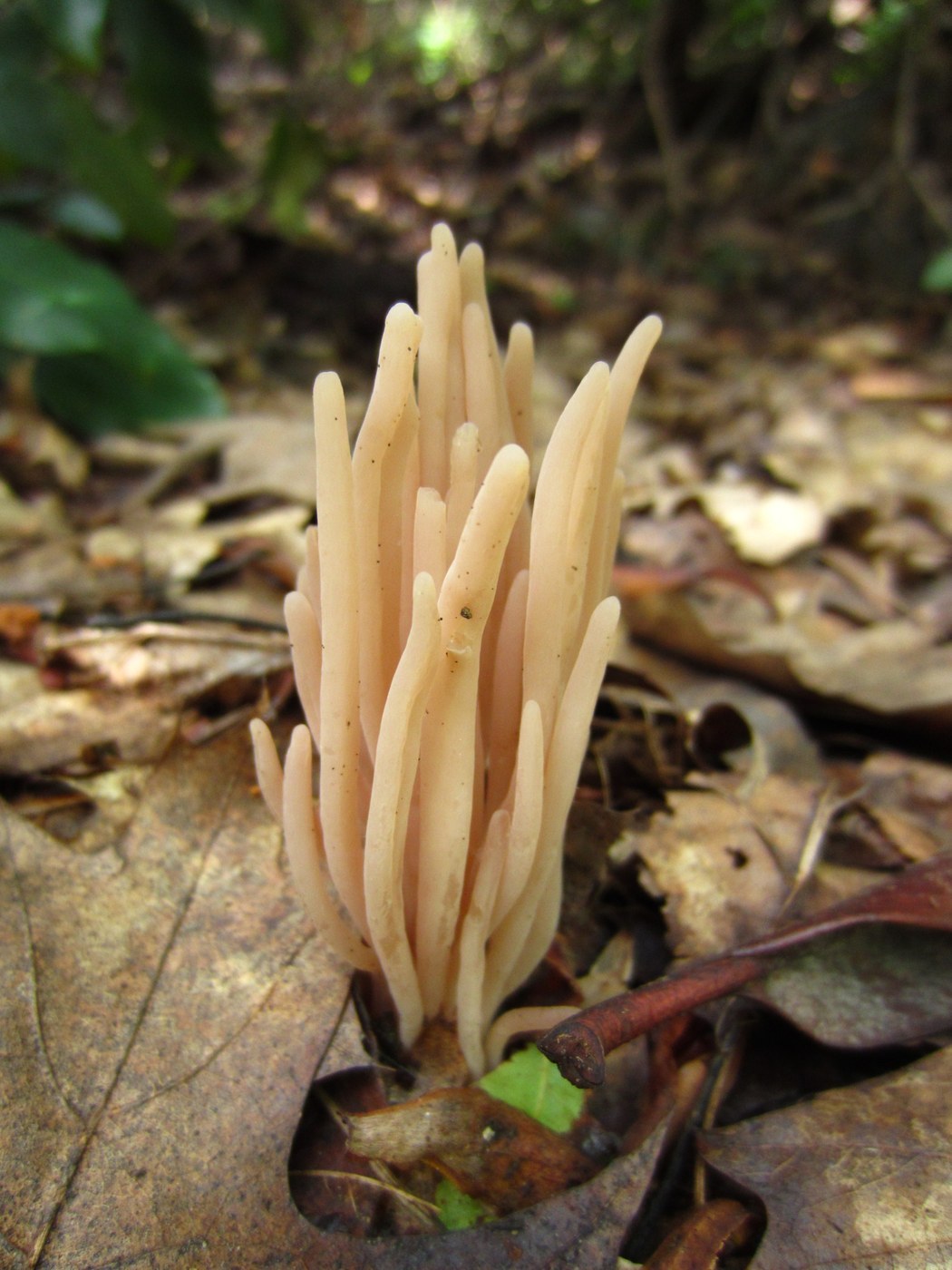
Smoky Spindles
Clavaria fumosa
Also called smoky club, smoky worm coral
A grassland club fungus forming dense tufts of slim, unbranched, smoke-grey to pale pinkish-grey spindles that are hollow and very brittle. It is one of the classic indicator fungi of ancient, low-fertility turf.
- Group
- Corals & Clubs
- Cap
- Slender grey unbranched clubs in tight clusters
- Spore print
- White
- Habitat
- Old unimproved grassland, lawns, mossy pasture
- Season
- Late summer to autumn
Overview
Smoky Spindles is a member of Clavaria, a genus of simple club and spindle fungi that never branch and never form a cap. Instead the entire fruiting body is a slim, upright, fertile column with the spore-bearing surface spread over its outer skin. Clavaria fumosa is among the most easily named members of the group because of its distinctive dull, smoky, faintly lilac-grey colouring, which is quite unlike the whites, yellows and violets of its relatives.
The genus belongs to the Clavariaceae, a family whose members are strongly associated with old, undisturbed, nutrient-poor grassland. In Europe these turf communities are surveyed using the so-called CHEGD fungi — Clavariaceae, Hygrocybe, Entoloma, Geoglossum and Dermoloma — and Smoky Spindles is a reliable member of that assemblage. Its presence usually indicates a sward that has gone many decades without ploughing or fertiliser.
Because the fruiting bodies are unbranched, soft and hollow, they collapse quickly after heavy rain or frost. A colony can be conspicuous one week and reduced to grey smears the next, so surveying for this species depends heavily on timing.
How to identify it
Fruiting body
Forms crowded tufts of 10 to 40 or more unbranched clubs, each roughly 3 to 12 cm tall and 3 to 8 mm thick. The clubs are cylindrical to narrowly spindle-shaped, often slightly flattened or grooved lengthwise, and frequently twisted or curved so that a cluster looks like a bundle of grey wax tapers. The tips are blunt to bluntly pointed and often discolour ochre-brown or blackish with age.
Surface and colour
The surface is smooth, dry and dull, without any polish or slime. Colour is the key feature: pale smoke grey, often with a faint pinkish, buff or lilac cast, and typically slightly paler toward the base. Old or weathered specimens fade toward dingy cream, while the extreme tips darken.
Stipe
There is no true separate stipe. The lower few millimetres are usually paler, sometimes almost white, and slightly narrowed where the clubs merge into the turf, but there is no distinct stalk, ring or basal disc.
Flesh and spore print
The flesh is white, thin, hollow at maturity and extremely brittle — a club snaps cleanly like a piece of chalk rather than bending. The spore print is white. Microscopically the spores are smooth and elliptical, and the basidia have four sterigmata, which separates Clavaria from the two-spored Clavulina group.
Where and when it grows
Smoky Spindles grows in short, mossy, species-rich turf: old churchyards, unfertilised meadows, upland pasture, coastal grassland, lawns that have never been treated, and grassy dune slacks. It strongly prefers ground that is low in nitrogen and phosphate, and it disappears rapidly from grassland that is ploughed, reseeded or heavily fertilised.
Fruiting runs from late summer through autumn, peaking after cool, wet spells, and can continue into early winter in mild maritime climates. The species is widespread across temperate Europe, where it is best documented, and comparable populations are recorded across northern North America and parts of temperate Asia. Records are patchy simply because suitable ancient turf has become scarce.
Ecological role
Traditionally the grassland clavarioid fungi were treated as straightforward saprotrophs, recycling dead grass roots and organic matter in the upper soil. More recent stable-isotope and root-sampling work suggests that many Clavariaceae maintain a closer, possibly biotrophic relationship with the roots of grasses and sedges, which would explain their tight fidelity to undisturbed swards and their inability to recolonise improved land.
Whatever the exact strategy, the mycelium is long-lived and slow to spread, sitting in the top few centimetres of soil where mosses and fine turf are densest. Fruiting bodies emerge only when soil moisture and temperature are right, which is why colonies appear to vanish for years and then return in force. As an ecological signal, a good stand of Smoky Spindles marks a grassland with an intact soil profile and continuous management history.
Similar species
Clavaria fragilis (White Spindles) shares the same grassland habitat and clustered, brittle, unbranched form but is pure white to cream, only yellowing or browning at the very tips, so a side-by-side comparison makes the grey of C. fumosa obvious. Clavaria zollingeri is equally clustered but vividly amethyst-violet and usually branched at the tips, not simple spindles. Clavulinopsis luteoalba is a slimmer orange-buff to salmon club with a distinctly whitish tip, again a colour difference rather than a structural one.
Clavulina cinerea (Grey Coral) can approach the same ash-grey tone but is repeatedly and obviously branched into short antler-like arms rising from a common stem, and its flesh is tougher and more pliant instead of snapping cleanly. Grey Clavaria species growing in woodland litter rather than open turf should also prompt a second look, since habitat is one of the more reliable separators in this group.