Spring Polypore
Lentinus arcularius
Also called fringed polypore, spring bracket
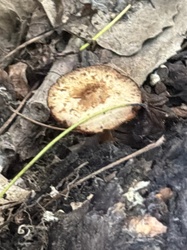
A small centrally stalked polypore with a scaly tan cap edged in coarse hairs and unusually large angular white pores that run down the stem.
Overview
The Spring Polypore is one of the earliest wood-rotting fungi to fruit in temperate deciduous woodland, often appearing on fallen branches while the canopy is still opening. Long known as Polyporus arcularius, it has been transferred to Lentinus on molecular grounds, joining a group of tough, stalked, white-rotting polypores in the family Polyporaceae.
Its distinguishing character is the combination of a small scaly cap with a conspicuously hairy, fringed margin and a pore layer whose openings are large enough to see clearly without a lens. Those pores are angular and often somewhat elongated along the radius, giving the underside a coarse honeycomb look quite unlike the near-smooth undersides of many other small polypores.
Widely distributed across Europe, Asia, Africa and the Americas, it is one of the more cosmopolitan stalked polypores, and in warmer regions it may fruit well beyond a narrow spring window. In cooler temperate zones, however, it lives up to its common name, following on almost directly from the winter fruiting of its close relative Lentinus brumalis.
How to identify it
Cap
The cap is 1 to 8 cm across, at first convex, soon flat and then shallowly depressed or funnel-shaped at the centre. The colour is warm tan to yellow-brown or ochre-brown, sometimes darkening toward the middle, and the surface bears small flattened brownish fibrillose scales that are most concentrated centrally. The single best character is the margin, which carries a fringe of coarse, stiff, dark hairs that projects visibly beyond the cap edge and persists well into maturity.
Pores
The pore surface is white to cream, ageing pale buff. Pores are large and openly angular to hexagonal, about 1 to 2 per millimetre and often radially elongated, so the underside reads as a coarse honeycomb visible to the naked eye. The pore layer is decurrent, running distinctly down the upper stem.
Stipe
The stipe is central, slender, 1 to 6 cm long and 2 to 6 mm thick. It is buff to brownish, finely scurfy or minutely scaly, sometimes slightly darker toward the base but never abruptly black. In fruit bodies emerging from the side of a branch the stem may be somewhat off-centre.
Flesh and spore print
The flesh is thin, white, and distinctly tough and pliant, drying rigid. It shows no colour change when cut or bruised. The spore deposit is white.
Where and when it grows
The Spring Polypore fruits on dead deciduous wood, favouring fallen branches, sticks, small logs and attached dead limbs. Recorded substrates include oak, beech, birch, maple, hickory, willow, poplar, ash and many other broadleaves, and in warmer regions a wide range of additional hardwoods. It prefers wood that is recently dead and still firm rather than deeply rotted.
In temperate zones it appears from mid-spring into early summer, often in the same weeks as morels and other spring fungi, and may put out a second smaller flush after summer rains. Its distribution is broad, covering Europe, temperate and tropical Asia, parts of Africa, and much of North and Central America, where it occurs in deciduous and mixed woodland, along woodland edges, in hedgerows, and in parks and gardens with fallen hardwood debris.
Ecological role
This species is a saprotroph producing a white rot, degrading both lignin and cellulose so that the colonised branch becomes pale, soft and fibrous. It is an early coloniser of freshly fallen branch wood, establishing quickly from spores on newly exposed surfaces and fruiting within a year or two of the branch coming down.
By targeting medium-sized branch debris it occupies an ecological position between the twig specialists and the large-log decomposers, helping to move a substantial fraction of woodland carbon back into the soil. The softened wood it leaves behind holds moisture and provides tunnelling substrate for beetles and other invertebrates, while the tough annual fruit bodies dry and persist on the branch long after spore release has finished.
Similar species
Lentinus brumalis, the Winter Polypore, is the closest match in shape and stature but has much smaller round pores at 2 to 4 per millimetre, a plain greyish-brown velvety cap without persistent marginal hairs, and a cold-season fruiting period. Neofavolus alveolaris shares the large hexagonal pores but its pores are even larger and more strongly radially stretched, its cap is orange to reddish-orange when fresh, and its stem is short and lateral or strongly off-centre rather than central.
Polyporus tuberaster can look like an oversized Spring Polypore, with a scaly cap and fringed margin, but it is far larger and thicker-fleshed and typically arises from a hard, soil-bound underground sclerotium. Picipes badius is separated at a glance by its smooth glossy chestnut cap, minute pores and sharply blackened lower stem.
Common questions about Spring Polypore
What is the most reliable field character?
When and where should I look for it?
Are the pores really that large?
How is it related to the Winter Polypore?
Spring Polypore found by the community
Photos submitted through the app and matched to this entry.