Sulphur Tuft
Hypholoma fasciculare
Also called clustered woodlover, sulfur tuft
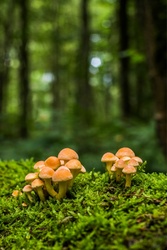
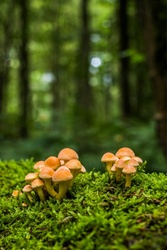
A very common stump fungus forming crowded tufts of small sulphur-yellow caps with rusty centres, sulphur-yellow gills that age greenish then purple-brown, and a purple-brown spore print.
Overview
Hypholoma fasciculare is the most abundant of the woodlovers, a genus of dark-spored agarics in the Strophariaceae that fruit in tight clusters on dead wood. The genus name refers to the veil remnants that hang like threads from the cap margin of young fruitbodies, and fasciculare to the bundled, tufted growth habit.
It is often the first fungus a beginner learns on stumps, because it is present nearly year-round, fruits in large showy tufts, and has a colour combination that few other wood mushrooms match: bright greenish-sulphur yellow overall with a warm tawny or rust-orange cap centre.
The critical structural point is the spore colour. Everything about young Sulphur Tuft is yellow, yet the mature gills darken through olive-green to a smoky purple-brown as spores ripen, and the print is decidedly purple-brown. That single character separates the genus cleanly from the white-spored Armillaria and the rusty-spored Galerina and Gymnopilus that share its habitat.
How to identify it
Cap
2-7 cm across, convex and often bluntly umbonate, expanding to nearly flat. The colour is sulphur-yellow to greenish-yellow with a distinctly darker tawny, orange-brown or rust-coloured centre. The surface is smooth and dry, and the margin of young caps carries fine, fleeting yellowish veil fibres.
Gills
Crowded, narrow and adnate. They begin sulphur-yellow, pass through a striking greenish or olive phase, and finally become smoky purple-brown as the spores mature - a colour sequence that can be seen across a single tuft of different-aged caps.
Stipe
4-12 cm long and 3-10 mm thick, slender, often curved or sinuous as fruitbodies compete inside a tuft. It is yellow above and rusty brown toward the base, fibrous and hollow with age. There is no true ring, though a faint darkened ring zone may be left where the cortina-like veil detached.
Flesh & spore print
Flesh is thin, yellow in the cap and browner in the lower stem, without dramatic bruising reactions. The spore print is purple-brown to dark chocolate-purple, and mature tufts often dust the caps beneath them with a dark deposit.
Where and when it grows
It fruits in dense clusters of a dozen to a hundred fruitbodies on stumps, fallen trunks, buried roots, sawdust and woodchip, on both broadleaf and coniferous wood. Beech, birch and oak stumps are typical, and it is equally at home on pine and spruce, which makes it far less host-specific than most stump fungi.
Sulphur Tuft can be found from spring to early winter, with a heavy peak from late summer through autumn, and old blackened tufts persist well beyond that. It is one of the most widespread wood-decay agarics in the world, common throughout Europe, North America, Asia and temperate Australasia, including in gardens, parks and woodchip beds.
Ecological role
The species is saprophytic, causing a white rot in dead wood and colonising both freshly cut stumps and long-fallen material. It is an aggressive early coloniser: its mycelium spreads quickly through a stump and often occupies it ahead of slower competitors, which is why a newly felled tree can be smothered in yellow tufts within a season or two.
Because it accepts both hardwood and conifer substrates and tolerates disturbed ground, it is a pioneer in clear-fells, woodchip mulch and garden borders. Its rapid decay of stumps and buried roots opens the wood to beetles and springtails and accelerates the return of nutrients to the soil, though it also competes directly with other stump specialists such as Velvet Shank, which avoids the conflict by fruiting in winter.
Similar species
The Conifer Tuft (Hypholoma capnoides) is very similar in shape and habit but has a duller tan-orange cap and, decisively, grey to smoky-grey gills that never pass through a yellow or green phase; it is restricted to conifer wood. The Brick Cap (Hypholoma lateritium) is larger and more robust with a brick-red to rusty cap, a paler margin, and whitish then grey-brown gills.
Honey Fungus (Armillaria mellea) also clusters on stumps but has a thick woolly ring, pale cream gills and a white spore print. Gymnopilus junonius is much bigger and golden-orange with a dry scaly cap, a ring, and a rusty-brown print. The Funeral Bell (Galerina marginata) is smaller and tawny-brown with rusty gills, a ring zone and rusty-brown spores.
Common questions about Sulphur Tuft
What colour is the spore print?
How does it differ from Conifer Tuft?
Does it grow on conifers as well as hardwoods?
What role does it play in a woodland?
Sulphur Tuft found by the community
Photos submitted through the app and matched to this entry.