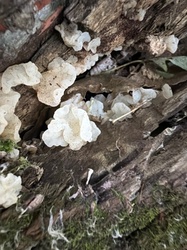
White Coral Jelly
Tremella fuciformis
Also called snow fungus, silver ear, white jelly fungus, white wood ear
A cluster of thin, translucent white gelatinous lobes that fan out from dead branches like a frozen flower or a piece of crumpled tissue. Its near-colourless, seaweed-like fronds set it apart from every other jelly fungus.
Overview
Tremella fuciformis forms one of the most elegant fruit bodies among the jelly fungi: a loose rosette of thin, wavy, almost glassy white lobes that can reach the size of a fist when fully expanded. The specific epithet refers to a resemblance to seaweeds of the genus Fucus, and the frilly, water-swollen fronds do indeed look more marine than fungal.
The genus Tremella belongs to the Tremellomycetes, a group of basidiomycetes with septate basidia divided into four cells. Almost all members are mycoparasites — fungi that attack other fungi — and their gelatinous fruit bodies erupt from wood only where the mycelium of a host fungus is already established inside.
The species is essentially pantropical to warm-temperate, common through East and Southeast Asia, and recorded in the tropical Americas, Africa and Australasia. In cooler regions it is replaced by other white jellies, so a truly frilly, translucent white Tremella in a temperate woodland is worth examining closely.
How to identify it
Fruit body
The fruit body is 3–10 cm across, occasionally larger, and consists of numerous thin, leaf-like or petal-like lobes attached to a small common base. The lobes are strongly undulating and crisped at their edges, 1–3 mm thick, and semi-transparent so that light passes through them.
Colour and surface
Colour is pure white to very faintly cream or pinkish-white; some collections take on a slight yellowish tone with age or sun exposure. The surface is smooth, slippery and glistening when wet. In dry weather the whole fruit body shrivels to a small hard, horny, off-white nodule pressed against the bark, and swells back to full size within hours of rain.
Flesh and spore print
The flesh is uniformly gelatinous throughout with no firm core, no stalk, no gills and no pores; the entire outer surface is fertile. It does not change colour when torn. The spore deposit is white, and the basidia are longitudinally septate into four cells, a defining microscopic character of the genus.
Where and when it grows
White Coral Jelly grows on dead, usually barked branches and small fallen trunks of broadleaf trees, frequently on wood still hanging in the canopy or recently fallen. It is a fungus of humid, warm forest, appearing after heavy rain and vanishing quickly in dry spells.
Its range covers the tropics and subtropics worldwide, with the greatest abundance in monsoonal East and Southeast Asia. Fruiting follows rainfall rather than a fixed calendar season, so fruit bodies can appear at almost any point in a wet year.
Ecological role
The species is a mycoparasite. Its mycelium does not decay wood directly but instead invades the mycelium of ascomycetes in the Annulohypoxylon and Hypoxylon group that are already rotting the branch. The jelly emerges through the bark exactly where the host fungus is active, which is why fruit bodies so often sit beside the black, crusty stromata of those ascomycetes.
This two-fungus requirement shapes its distribution: the jelly can only appear where both the right host and the right moisture conditions coincide. The gelatinous tissue itself is an adaptation to intermittent rain, allowing the fruit body to dry to a hard nodule, survive weeks of drought, and rehydrate to release spores when water returns.
Similar species
Tremella mesenterica has the same brain-like gelatinous construction but is bright golden-yellow to orange, and its lobes are blunter and more convoluted than the thin frilly blades of T. fuciformis. Phaeotremella frondosa is similar in overall frondose shape but dull brown to reddish-brown throughout.
Among white jellies, Exidia thuretiana forms coalescing white blobs and cushions rather than distinct petal-like lobes, and Ductifera pululahuana is a firm, opaque, gumdrop-like white mass without frilly margins. Auricularia species share the translucent gelatinous flesh but form ear- or cup-shaped brackets with one smooth fertile face and one velvety upper face, quite unlike a symmetrical rosette of blades. True coral fungi such as Clavulina are dry and brittle, snapping cleanly rather than flexing.
Common questions about White Coral Jelly
How can I be sure it is a jelly fungus and not a coral fungus?
Why does it appear right next to black crusty patches on the branch?
Where does it disappear to between rains?
Is it found in cool temperate woodland?
White Coral Jelly found by the community
Photos submitted through the app and matched to this entry.