
Community find
White Jelly Fungus
Tremella fuciformis
- Group
- jelly fungus
- Spore print
- White
- Size
- Fruiting bodies generally range from 2 to 7 cm across and 2 to 4 cm high.
- Season
- Primarily late summer and autumn, but can appear year-round in humid tropical and subtropical climates after heavy rain.
- Habitat
- Grows on the dead wood of broadleaf trees. Historically associated with specific host fungi in the genus Annulohypoxylon or Hypoxylon, which it parasitizes.
- Distribution
- Widespread in tropical and subtropical regions worldwide, including Asia, Central America, and the southeastern United States.
- Key characteristics
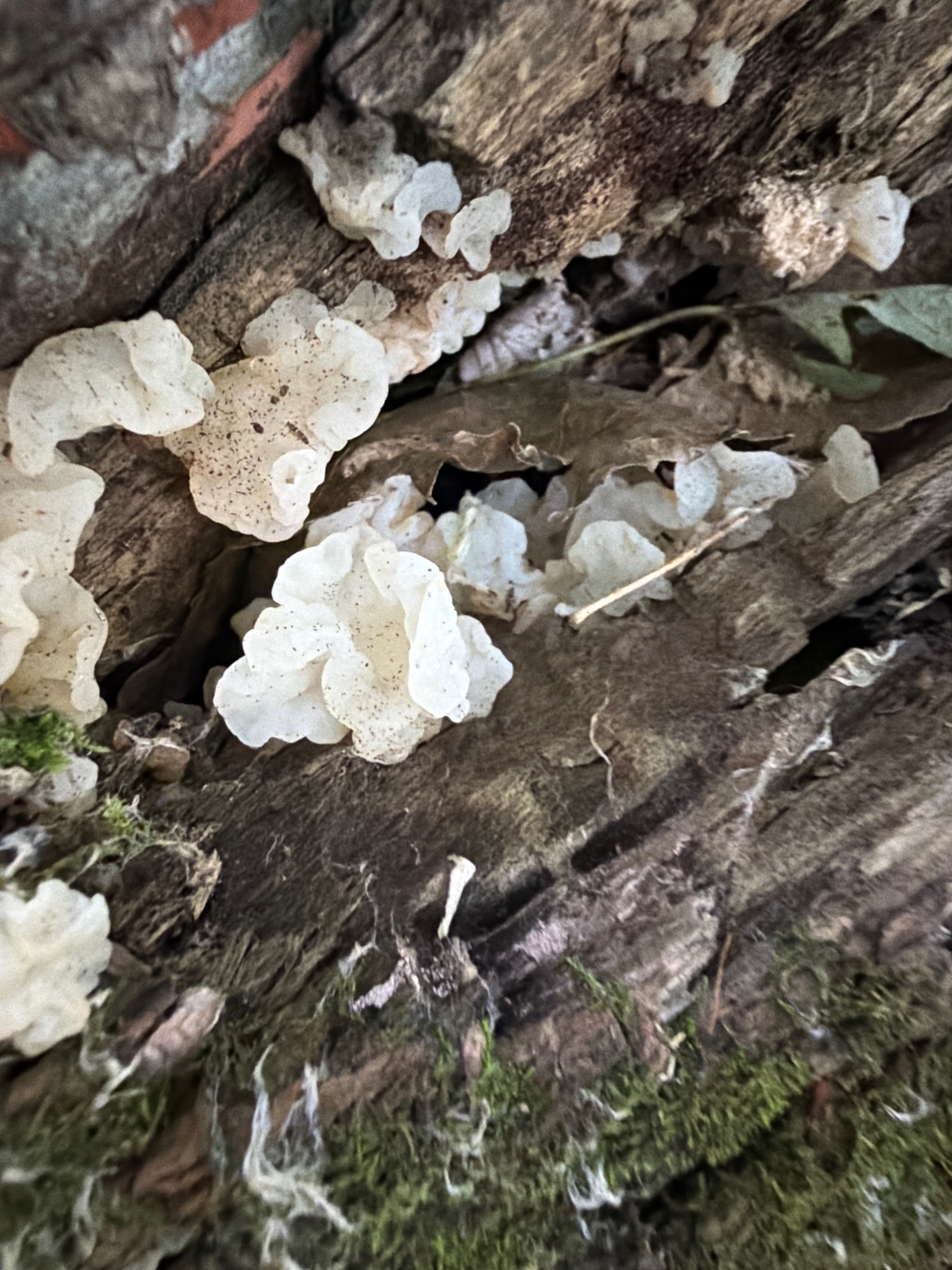
- Gelatinous, watery consistency when wet, becoming bone-like or thin when dry. Translucent white to creamy white color. Branched, seaweed-like lobes or ruffles. Surface is smooth and slimy to the touch.
- Fruiting body
- Fruiting body is a branched, gelatinous mass of graceful, undulating lobes. These lobes are thin, translucent, and often described as looking like a white carnation flower or seaweed. There is no distinct stipe or cap; the entire structure is the hymenophore.
- How to recognise it
- Look for pure white, translucent, gelatinous lobes growing on hardwood logs. It often appears after significant rain and will shrivel into a hard, yellowish film when dry.
- Look-alikes
- Ductifera pululahuana (White Brain Fungus) which is typically more globose and less foliose; Exidia nucleata which contains small white mineral deposits (nuclei) within the jelly.
- Ecological role
- Mycoparasitic (parasitizes the mycelium of crust fungi in the genus Annulohypoxylon) rather than being a primary wood-decomposer.
- Notes
- This fungus is unique because it is a yeast-like organism that only forms its gelatinous fruiting body when it encounters its host fungus. It is a hallmark species in the study of fungal parasitism.